

Why Your First Bitcoin Purchase Doesn’t Have to Be Complicated
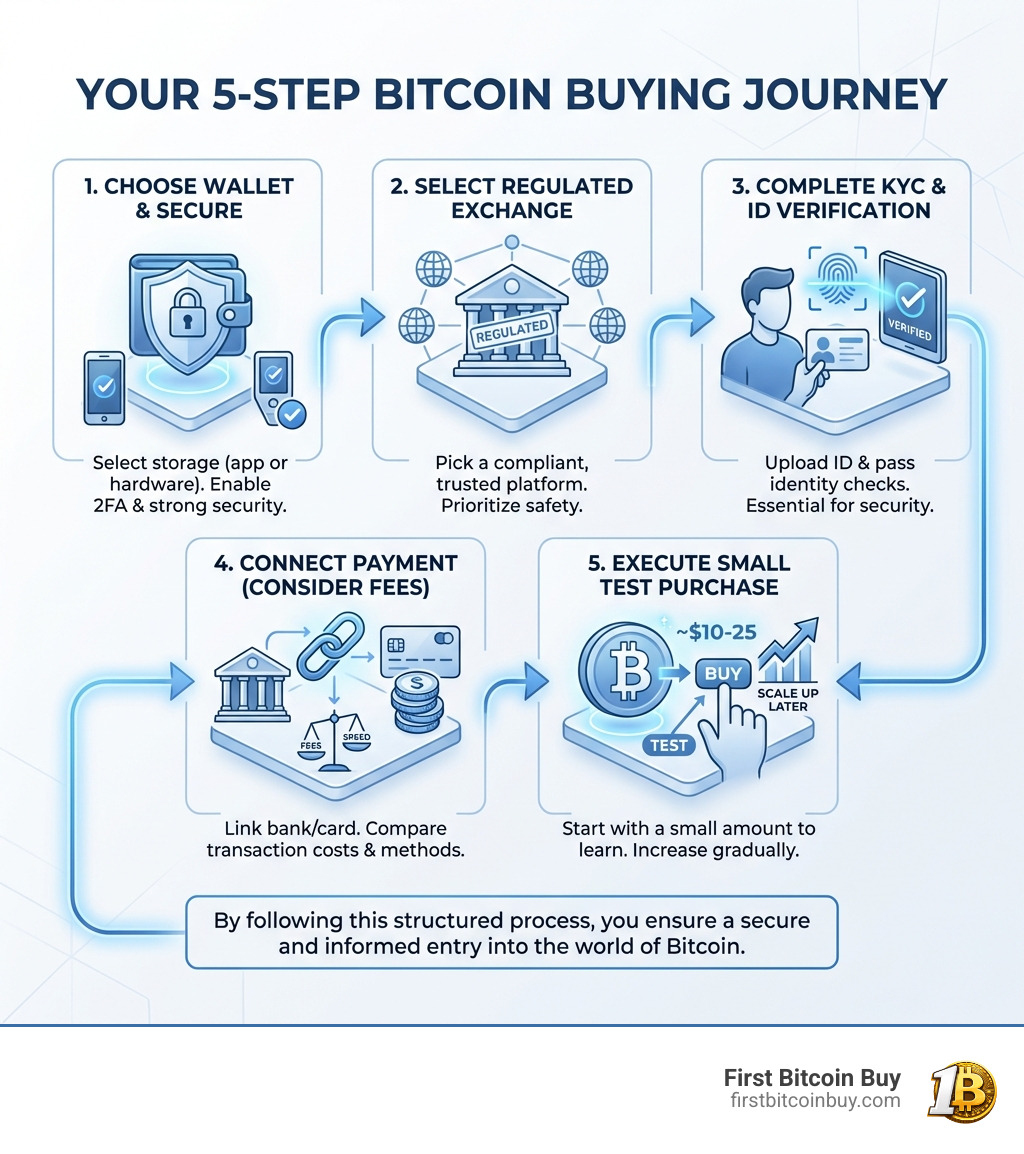
A step by step bitcoin purchase is simpler than most people think, but doing it safely requires following the right sequence. Here’s the essential process:
- Choose a secure wallet – Set up a place to store your Bitcoin (mobile app for beginners, hardware wallet for larger amounts)
- Select a regulated exchange – Pick a trusted platform like Coinbase that follows KYC requirements
- Complete identity verification – Upload your ID and complete security checks (usually takes minutes)
- Add a payment method – Connect your bank account or debit card (bank transfers have lower fees)
- Make your first purchase – Start small ($10-25 to learn), then scale up once comfortable
The key insight: Most beginners overcomplicate this. You don’t need to understand blockchain technology or market timing to make your first purchase safely. You just need to follow proven security practices and use a reputable platform.
The biggest mistake isn’t choosing the wrong moment to buy – it’s choosing the wrong platform or skipping basic security steps like two-factor authentication.
According to industry data, around 20% of Bitcoin (valued at approximately $140 billion) is lost forever because individuals forgot their passwords. This statistic highlights why proper preparation matters more than speed. Taking 30 minutes to set up security correctly is better than rushing and risking your investment.
I’m Randy Speckman, and I created First Bitcoin Buy specifically to help cautious newcomers steer their step by step bitcoin purchase with confidence and clarity, avoiding the common pitfalls that lead to lost funds or scam exposure. What follows is the exact process I recommend to everyone making their first Bitcoin transaction.
Preparing for Your First Bitcoin Purchase
Before hitting the “buy” button, you must lay a solid foundation. A little preparation ensures your step by step bitcoin purchase is secure. Our journey begins with understanding where your Bitcoin will live. For a deeper dive, explore our Bitcoin Beginner Guide.
Bitcoin assets are secured by cryptographic keys. A public address is like a bank account number you share to receive funds. A private key is your secret password; it grants access to spend your Bitcoin. Never share it. The mantra “not your keys, not your crypto” means if you don’t control your private keys, you don’t truly own your Bitcoin.
A “seed phrase” is a list of 12 or 24 words acting as a master key to recover your wallet. Keep this offline in a secure location. Losing it means losing your Bitcoin forever; approximately 20% of all Bitcoin is estimated to be lost due to misplaced keys. For more general info, see Getting started with Bitcoin.
Understanding Wallet Types
Wallets store your private keys and allow interaction with the network. We categorize them into two types:
Hot Wallets: Connected to the internet (mobile apps, desktop software).
- Pros: Convenient for frequent transactions, user-friendly.
- Cons: Susceptible to online attacks.
- Best for: Small amounts for active trading or spending.
Cold Wallets: Offline storage (hardware wallets like USB drives).
- Pros: Highly secure and resistant to hacking.
- Cons: Less convenient for daily use.
- Best for: Large amounts held for the long term.
As holdings grow, move assets from an exchange to your own cold wallet. To learn more, check out our guide on Crypto Wallets.
Essential Security Pre-Checks
- Two-Factor Authentication (2FA): Use an authenticator app (Google Authenticator) rather than SMS to prevent SIM-swapping attacks.
- Strong, Unique Passwords: Use a unique password for every crypto account. A password manager is recommended.
- Device Security: Keep your OS and antivirus updated. Avoid clicking suspicious links or downloading unknown apps.
- Never Share Your Seed Phrase: No legitimate service will ever ask for it. Anyone who does is a scammer.
Implementing these measures reduces the risk of falling victim to hacks. Our Bitcoin Safety Tips: Complete Guide is an invaluable resource.
Choosing the Right Platform: Centralized vs. Decentralized
For beginners, we recommend starting with a reputable, centralized exchange.
| Feature | Centralized Exchange (CEX) | Decentralized Exchange (DEX) / P2P |
|---|---|---|
| Regulation | Regulated (KYC, AML) | Generally unregulated |
| User Experience | Beginner-friendly | More complex |
| Security | Exchange custody | Self-custody |
| Liquidity | High | Varies |
| Payment Methods | Bank, Card, PayPal | Bank, Cash, Gift cards |
Centralized exchanges (CEXs) like Coinbase act as intermediaries, offering robust interfaces and customer support. They are ideal for converting fiat into Bitcoin. Decentralized exchanges (DEXs) and P2P platforms allow direct trading but carry higher risks, including scams and lack of legal recourse. For a safe start, visit our Where to Buy Bitcoins Safely Guide.
The Role of KYC and Regulation
U.S. exchanges require Know Your Customer (KYC) verification to combat money laundering. You will typically need to provide your name, address, a government-issued ID, and a “liveness check” (selfie). While it feels intrusive, these regulations offer protection and legitimacy. For more on U.S. platforms, see How Platforms Can Help You to Buy Bitcoin in USA.
Payment Methods and Fees
- Bank Transfers (ACH/Wire): Cheapest option, but takes 3-5 days to clear.
- Debit Cards: Faster and often instant, but carry higher fees (1.5% to 4%).
- Credit Cards: Instant but very expensive due to “cash advance” fees and high interest. Many banks block these transactions.
- PayPal: Convenient for existing users, though withdrawal limits apply.
Always review the fee structure before confirming. For details, refer to The Ultimate Guide to Buying Bitcoin with Credit, Debit, or Cash.
The Step-by-Step Bitcoin Purchase Process
With security in place, we are ready for the step by step bitcoin purchase. If you’re ready, our Start Buying Bitcoin page is a great resource.
Setting Up Your Account
We recommend Coinbase for its user-friendly interface. The process is similar across most CEXs:
- Registration: Sign up with your email and enable 2FA immediately.
- Personal Info: Provide your legal name, date of birth, and address.
- ID Upload: Upload a clear image of your driver’s license or passport.
- Verification: Complete the liveness check if prompted.
- Connect Payment: Link your bank account or card.
Verification usually takes minutes. For specific guidance, see our Coinbase Signup guide.
Executing Your First Purchase
- Fund Your Account: Deposit funds via bank transfer or use a card for instant purchase.
- Steer to “Buy”: Click the “Buy/Sell” button on the platform.
- Select Bitcoin (BTC): Choose BTC from the list.
- Enter Amount: You can buy fractions of a Bitcoin.
- Review and Confirm: Check the price and fees before clicking confirm.
Beginner’s Tip: Start Small! Make a test purchase of $10-$25 to understand the process. Once comfortable, consider Dollar-Cost Averaging (DCA)—investing a fixed amount at regular intervals to reduce the impact of volatility. For a detailed walkthrough, see our Step-by-Step Guide to Buying Bitcoin.
Avoiding Scams and Protecting Your Investment
Avoiding scams is paramount. Watch for these red flags:
- Fake Giveaways: No one will “double your Bitcoin.”
- Guaranteed Returns: High returns with no risk are always a scam.
- Phishing: Always double-check URLs. Bookmark official exchange sites.
- Malicious Apps: Only download from official app stores.
Your vigilance is your best defense. For in-depth advice, visit our Safely Buy Crypto guide.
Verifying Platform Legitimacy
- Research Reviews: Look for consistent complaints about withdrawal issues.
- Check Regulation: Ensure the platform is registered with financial authorities.
- Website Security: Look for “HTTPS” and professional design.
Our Safe Crypto Investment guide offers more tips.
Moving Assets to Long-Term Storage
Keeping large amounts on an exchange carries risk. Moving to a hardware wallet gives you full control:
- Acquire a Wallet: Buy directly from manufacturers like Ledger or Trezor.
- Set Up: Generate your seed phrase and PIN.
- Withdraw: On the exchange, enter your hardware wallet’s Bitcoin address.
- Verify: Double-check the address and send a small test transaction first.
This ensures your Bitcoin is stored securely offline. For more, explore After Your First Buy.
Post-Purchase Considerations: Taxes and Management
Taxes
The IRS classifies Bitcoin as property. Key points include:
- Buying: Generally not a taxable event.
- Selling/Trading/Spending: These trigger capital gains or losses.
- Records: Keep dates, cost basis, and fair market values for all transactions.
Consult a qualified accountant for compliance. Read more about Accounting and taxes.
Managing Your Portfolio
- Only Invest What You Can Lose: Bitcoin is volatile.
- Use DCA: Average your purchase price over time.
- Avoid Emotions: Don’t panic sell during dips.
- Stay Informed: Follow reliable news sources.
For strategy planning, see our How Much to Buy Bitcoin: Complete Guide.
Frequently Asked Questions about Buying Bitcoin
What is the minimum amount of Bitcoin I can buy?
Bitcoin is divisible into “satoshis” (0.00000001 BTC). Most exchanges allow purchases as low as $10. See our Minimum Bitcoin Purchase guide.
How long does it take to receive my Bitcoin?
Debit cards and PayPal are often instant. Bank transfers take 3-5 days. Once sent to an external wallet, the network takes 10-30 minutes to confirm the transaction.
Is buying Bitcoin with a credit card a good idea?
We advise against it. You will likely face cash advance fees, high interest rates, and potential bank blocks. Debit cards or bank transfers are more cost-effective.
Conclusion
Starting on your step by step bitcoin purchase journey can feel like a big leap, but with the right guidance, it’s an accessible and secure process. We’ve walked through the essentials: from understanding wallet types and fortifying your security, to choosing a reliable platform like Coinbase, navigating payment methods, and executing your first buy. We’ve also highlighted the critical importance of avoiding scams and understanding the tax implications of your investment.
Our mission at First Bitcoin Buy is to explain this process, offering clear, beginner-friendly instructions rooted in real-world experience. The key to a successful first Bitcoin purchase isn’t about perfectly timing the market; it’s about prioritizing security, choosing reputable platforms, and taking a measured, informed approach.
By following these steps, you’re not just buying Bitcoin; you’re building a foundation for informed and responsible participation in the exciting world of digital assets. We’re here to guide you every step of the way. For a comprehensive resource to continue your journey, explore our Ultimate Buy Bitcoin Guide.