
Why Every Bitcoin Beginner Needs a Checklist Before Their First Purchase
A bitcoin beginner checklist is your roadmap to safely entering cryptocurrency without falling victim to scams, losing your funds, or making costly mistakes. Here’s what you need to cover before buying your first Bitcoin:
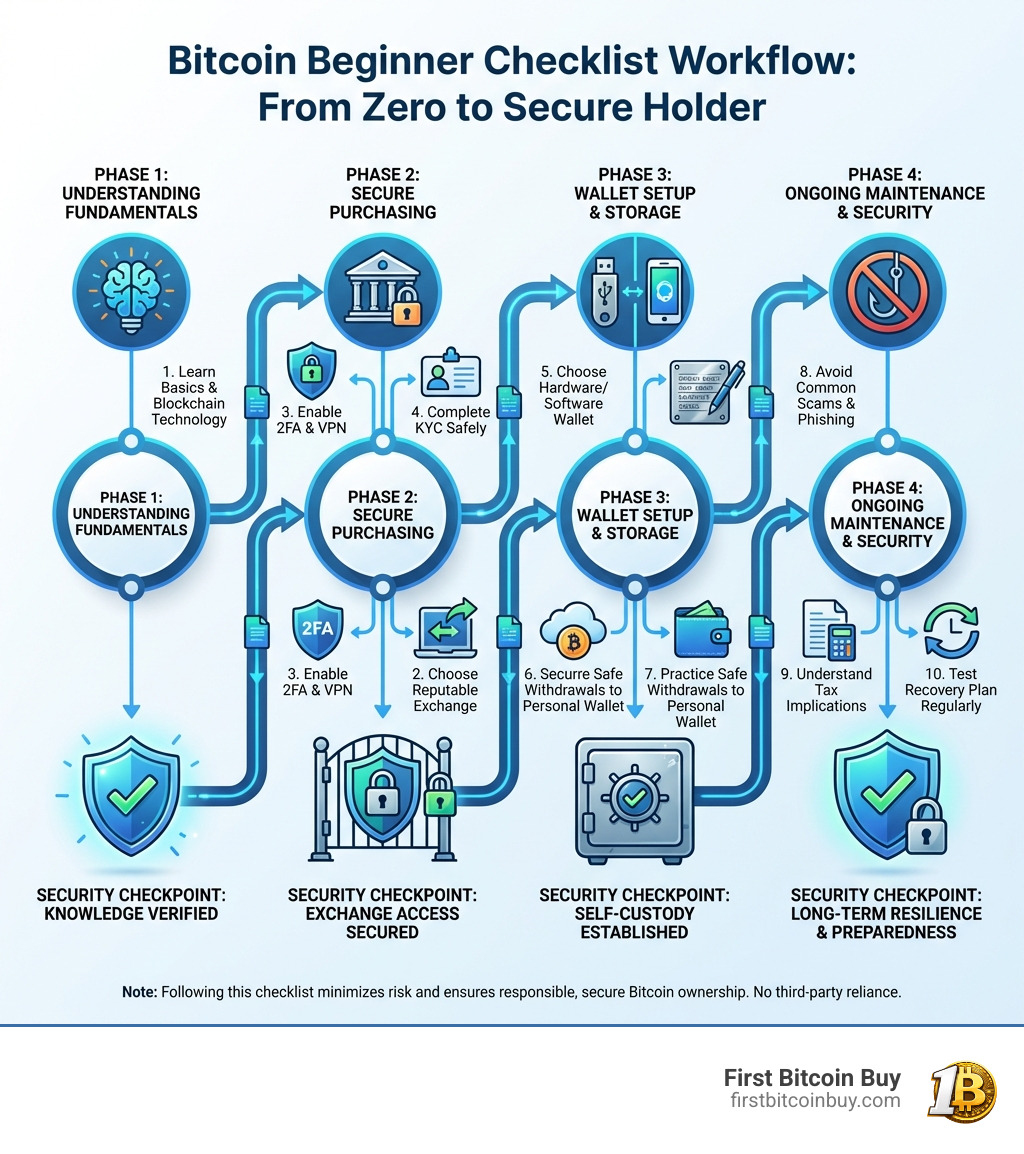
Essential Bitcoin Beginner Checklist:
- Understand the basics – Learn what Bitcoin is and how blockchain technology works
- Choose a secure exchange – Select a reputable, regulated platform for your first purchase
- Enable security features – Set up Two-Factor Authentication (2FA) and use a VPN
- Complete identity verification – Prepare for KYC requirements safely
- Set up a wallet – Choose between hardware and software wallets for storage
- Secure your seed phrase – Back up your recovery words offline, preferably on metal
- Practice safe withdrawals – Transfer Bitcoin from exchange to your personal wallet
- Avoid common scams – Learn to spot phishing attempts and fake giveaways
- Understand tax implications – Know your reporting obligations from day one
- Plan for recovery – Test your backup process before storing significant value
Bitcoin is back in the news, and as The New York Times once put it, “Everyone is getting hilariously rich and you’re not.” But rushing in without preparation is exactly how beginners lose money. The research shows that over 99% of unsolicited messages to Bitcoin beginners are scams, and critical mistakes like losing your private keys are completely irreversible—no bank or support team can fix them.
The digital currency revolution is still in its infancy, even though Bitcoin has been around for over a decade. While there are more than 1,300 altcoins representing nearly 40% of the cryptocurrency market cap, starting with Bitcoin remains the safest entry point for newcomers.
The stakes are high because Bitcoin gives you complete financial sovereignty—but that means you’re also completely responsible for your security. Unlike traditional banking, there’s no customer service line to call if you send funds to the wrong address or fall for a scam. This is why following a structured bitcoin beginner checklist isn’t optional—it’s essential.
I’m Randy Speckman, creator of First Bitcoin Buy, and I’ve guided hundreds of everyday people through their first Bitcoin purchase with confidence and clarity. This bitcoin beginner checklist distills years of practical experience into actionable steps that prioritize security, self-custody, and long-term thinking—without hype or unnecessary risk.
Phase 1: Understanding the Fundamentals
Before we spend a single cent, we need to understand what we are actually buying. Bitcoin is not just a digital stock; it is a form of money.
What is Bitcoin and How Does it Work?
Bitcoin is a decentralized digital currency that operates on a peer-to-peer network known as the blockchain. It was created in 2008 by an anonymous person (or group) using the pseudonym Satoshi Nakamoto. Unlike the US dollar, which is managed by the government and the Federal Reserve, Bitcoin has no central authority.
Think of the blockchain as a public, digital ledger that everyone can see but no one can forge. When we send Bitcoin, the network of computers (nodes) verifies the transaction to ensure we actually have the funds. This process removes the need for a “trusted” middleman like a bank.
Digital Scarcity: The 21 Million Rule
One of the most important items on our bitcoin beginner checklist is understanding scarcity. There will only ever be 21 million Bitcoins created. This is hard-coded into the software. This digital scarcity is why many refer to it as “digital gold.” While a government can print more money, which often leads to inflation, no one can “print” more Bitcoin.
To dive deeper into these core concepts, check out our What is Bitcoin: Complete Guide or read the original Bitcoin Whitepaper to see the technical brilliance behind the system.

Phase 2: The Bitcoin Beginner Checklist for Secure Purchasing
Once we understand the “why,” it’s time for the “how.” Buying Bitcoin for the first time in the United States requires a structured approach to ensure we don’t accidentally hand our bank details to a fraudster.
Choosing Reputable Exchanges
We always recommend starting with a well-regulated, US-based exchange. These platforms are required to follow strict security and financial laws. For most of our readers, we focus on helping you Safely Buy Crypto by using platforms like Coinbase, which offer a user-friendly entry point.
Security Precautions: VPNs and 2FA
Before you even create an account, we suggest two essential security steps:
- Use a VPN: A Virtual Private Network masks your IP address and encrypts your web traffic. This is especially important if you are ever checking your account on a network that isn’t your own.
- Enable 2FA: Two-Factor Authentication is non-negotiable. Do not use SMS-based 2FA (where they text you a code), as “SIM swapping” is a common scam. Instead, use an app like Google Authenticator that generates a fresh 6-digit code every 60 seconds.
The KYC Process
When you sign up, you will encounter “Know Your Customer” (KYC) requirements. This is a legal necessity in the United States to prevent money laundering. You’ll need to provide:
- Your full legal name and address.
- A photo of your government-issued ID (front and back).
- A “selfie” or facial recognition scan (which might involve making some “funny faces” for the camera to prove you are a real person).
For a detailed walkthrough of this process, visit our guide on Coinbase Signup Security.
Making the Purchase
You don’t have to buy a whole Bitcoin! You can start with as little as $10 or $20. This is called “fractional buying.” Most beginners start by linking their bank account via a secure service like Plaid to Buy Bitcoin with Bank Account on Coinbase.
Phase 3: Wallet Setup and Private Key Security
If your Bitcoin is sitting on an exchange, you don’t technically “own” it yet—you own an IOU from the exchange. To truly own your Bitcoin, you need to move it to a personal wallet. This is the “self-custody” portion of our bitcoin beginner checklist.
Hardware vs. Software Wallets
| Feature | Software Wallet (Hot) | Hardware Wallet (Cold) |
|---|---|---|
| Security | Lower (Connected to internet) | Highest (Offline storage) |
| Cost | Usually Free | $60 – $200+ |
| Convenience | High (Easy to spend) | Moderate (Requires device) |
| Best For | Small amounts/Daily use | Long-term savings (HODL) |
For more on how these work, read our Crypto Wallets Explained guide.
The Seed Phrase: Your Master Key
When you set up a wallet, it will give you a “seed phrase” (usually 12 or 24 random words). This phrase is your Bitcoin. If you lose your phone or your hardware device breaks, these words allow you to recover your funds.
- Never store your seed phrase digitally (no photos, no emails, no cloud storage).
- Never share it with anyone. No legitimate company will ever ask for it.
- Always write it down physically. We recommend “metal seed storage” (stamping the words into steel) to protect against fire or water damage.
Many Bitcoin Beginner Guide: Common Mistakes involve people losing their seed phrase or typing it into a fake website. Don’t let that be you!
Essential Steps for Your Bitcoin Beginner Checklist
- Generate a Receive Address: In your wallet, click “Receive” to see your Bitcoin address (a long string of letters and numbers).
- Withdraw from Exchange: Go to the exchange’s withdrawal page, paste your address, and double-check every single character.
- Confirm Fees: You will pay a small “network fee” to the miners who process the transaction.
- Wait for Confirmations: It usually takes about 10 to 30 minutes for a transaction to be fully “confirmed” on the blockchain.
For a step-by-step visual, see our Withdrawal Guide.
Security Precautions for a Bitcoin Beginner Checklist
- Phishing Awareness: Be wary of emails that look like they are from your exchange asking you to “verify your account” by clicking a link.
- Giveaway Scams: If someone on social media (even if they look like Elon Musk) promises to “double your Bitcoin” if you send them some first, it is 100% a scam.
- Password Managers: Use a tool to generate and store unique, strong passwords for your exchange accounts.
Phase 4: Advanced Ownership and Maintenance
Once you have secured your first purchase, you might want to move beyond the basics.
Running a Bitcoin Node
Running a “full node” means keeping a complete copy of the Bitcoin blockchain on a small computer (like a Raspberry Pi) at your home. This allows you to verify your own transactions without trusting anyone else. It’s the ultimate level of Bitcoin Safety Tips: Complete Guide. It requires some hardware (an SSD and a microSD card), but it gives you true financial sovereignty.
Spending and Accepting Bitcoin
Bitcoin isn’t just for holding; you can use it to buy goods and services. Many small businesses now use tablets or phones to accept Bitcoin payments. If you are a business owner, you can Find merchant services to help you start accepting “digital gold” today.
Tax Implications in the United States
In the U.S., the IRS treats Bitcoin as “property.” This means:
- Buying and Holding: Generally not a taxable event.
- Selling for Profit: You owe capital gains tax.
- Spending Bitcoin: This is technically “selling” your Bitcoin to buy a product, so it may trigger a taxable event.
We strongly suggest keeping a record of all your transactions and consulting our Tax Compliance Guide or a qualified accountant to stay on the right side of the law.
Frequently Asked Questions about the Bitcoin Beginner Checklist
How much Bitcoin should I start with?
We always suggest starting with an amount you are comfortable losing—not because Bitcoin is likely to go to zero, but because the volatility can be stressful for beginners. A popular strategy is “Dollar-Cost Averaging” (DCA), where we buy a small amount (say $25) every week regardless of the price. Check out our How Much to Buy Bitcoin: Complete Guide for more strategies.
How do I recover my Bitcoin if I lose my device?
As long as you have your seed phrase, you can recover your Bitcoin on any compatible wallet. You simply “import” the 12 or 24 words into a new device, and your funds will reappear. This is why the seed phrase is more important than the hardware itself.
Should I run a Bitcoin node as a beginner?
It is not required, but it is a fantastic learning experience. It helps you understand the “rules” of the network and provides you with the highest level of privacy. However, we recommend getting comfortable with buying and storing your Bitcoin first before tackling a node setup.
Conclusion
At First Bitcoin Buy, we believe that Bitcoin is the greatest tool for financial independence ever created. But like any powerful tool, it must be used with care. By following this bitcoin beginner checklist, you are already ahead of 90% of the people entering the market.
Remember our golden rules:
- Not your keys, not your Bitcoin. Move your funds to a private wallet.
- Verify, don’t trust. Use reputable exchanges and check addresses twice.
- HODL for the long term. Bitcoin is a marathon, not a sprint.
Ready to take the first step? Download our Free Bitcoin Beginner Checklist and start your journey to financial sovereignty today! For more guides and step-by-step instructions, visit our First Bitcoin Buy Homepage.