

You Don’t Need to Buy a Whole Coin
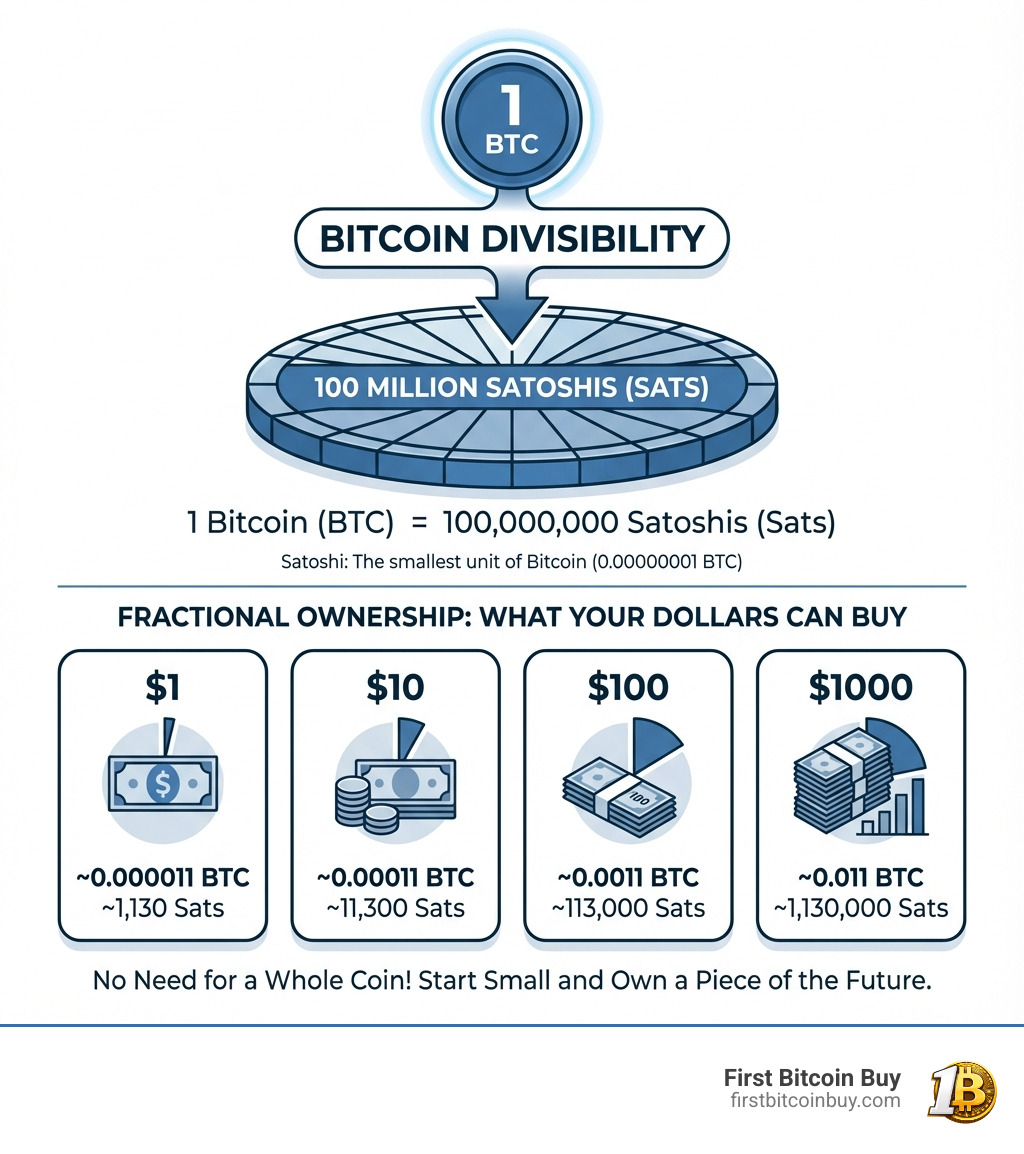
How much to buy bitcoin depends entirely on your budget and goals—not on Bitcoin’s total price. The beauty of Bitcoin is its divisibility: you can purchase as little as a few dollars’ worth, or even a single Satoshi (the smallest unit, equal to 0.00000001 BTC). You don’t need thousands of dollars to get started.
Quick Answer:
- Minimum Amount: You can buy Bitcoin starting from just $1-$10 on most exchanges
- Smallest Unit: 1 Satoshi = 0.00000001 BTC
- Current Rate: At $86,000-$91,000 per Bitcoin, $1 buys approximately 0.000012 BTC
- Exchange Minimums: Most platforms require trades equal to or over 0.0001 Bitcoin for all Bitcoin pairs
- Best Practice: Start small with what you can afford to lose
Think of Bitcoin like a pizza. You don’t have to buy the whole pie—you can purchase just one slice (pineapple optional). With Bitcoin, you decide how much to buy, sell, and trade. Whether it’s $10 or $10,000, the cryptocurrency works the same way.
The current Bitcoin price fluctuates between roughly $86,000 and $91,000 per BTC, with a total market cap exceeding $1.7 trillion. But these large numbers shouldn’t intimidate you. Because Bitcoin is divisible into 100 million Satoshis, anyone can participate regardless of their budget.
I’m Randy Speckman, and I’ve spent years helping newcomers understand how much to buy bitcoin without fear or confusion. My purpose-driven approach focuses on safe, measured strategies that explain cryptocurrency for first-time buyers.
Understanding Bitcoin’s Value and Volatility
Bitcoin, the world’s first decentralized digital currency, has a dynamic price that fluctuates constantly. Understanding this volatility and the factors influencing its value is crucial before you decide how much to buy bitcoin.

The current price of Bitcoin is a moving target, but as of recent data, it’s been hovering around the $91,439.66 mark per BTC. This figure changes by the second, reflecting global supply and demand, news events, and investor sentiment.
When we look at price changes over different timeframes, Bitcoin’s volatility becomes clear:
- Last 24 hours: Prices can shift significantly. For instance, recent data shows a change of +0.53% in the last 24 hours, but other snapshots indicate a 1.56% increase, or even a 0.28% increase in just the last hour. The amount of Bitcoin traded has also seen spikes, with a recent 24-hour trading volume reported at $83.87 billion, showing high activity.
- Last 7 days: The weekly performance can also vary widely. Some reports show a slight increase of 0.08%, while others indicate a decrease of -12.74%. This demonstrates how quickly the market can turn.
- Last 1 year: Over a longer period, Bitcoin has seen substantial growth. Looking back a year, Bitcoin has changed by $65,986.03 USD, representing a 31.32% increase. However, another source indicates a -1.09% change in the past year, highlighting that performance can be measured from different starting points and is not always linear. Bitcoin reached its highest price over the last year with a value of $125,115.28 per 1 BTC and its lowest at $76,674.44.
These fluctuations are part of what makes Bitcoin an exciting, yet high-risk, investment.
Bitcoin’s Market Cap and Supply
Beyond the price per coin, two other key metrics help us understand Bitcoin’s standing:
- Total Market Capitalization: This represents the total value of all Bitcoin currently in circulation. With a circulating supply of approximately 19,950,440 BTC, Bitcoin’s market cap recently stood at an impressive $1.82 trillion. This makes Bitcoin the largest cryptocurrency by market capitalization, often ranking #1 compared to other tokens.
- Circulating Supply vs. Maximum Supply: Unlike traditional currencies that can be printed indefinitely, Bitcoin has a finite supply. There will only ever be 21,000,000 BTC. Currently, around 19,950,440 BTC are in circulation, meaning about 95% of the total supply has already been mined. This scarcity, combined with increasing demand, is a fundamental factor influencing its value. The last Bitcoin is expected to be mined around the year 2140.
For more detailed information on its origins and how it works, you can find More info about What Is Bitcoin. You can also Read the original Bitcoin white paper to dive into Satoshi Nakamoto’s foundational vision.
Factors Influencing Bitcoin’s Price
Several factors contribute to Bitcoin’s price movements:
- Supply and Demand: This is the most fundamental economic principle at play. When demand for Bitcoin increases faster than its supply, the price tends to rise. Conversely, if demand falls, the price may drop.
- Halving Events: Approximately every four years, the reward miners receive for validating transactions is cut in half. These “halving” events reduce the rate at which new Bitcoin enters circulation, historically leading to price increases due to increased scarcity.
- Adoption and Utility: As more individuals, businesses, and institutions adopt Bitcoin for payments, investments, or other uses, its perceived value and demand grow. For example, recent news highlights how public companies collectively hold 666,835 Bitcoin, accounting for 3.15% of the total supply, and how spot Bitcoin ETFs have seen consistent inflows, indicating persistent institutional demand.
- Regulatory Environment: Government regulations and legal frameworks around cryptocurrency can significantly impact investor confidence and market sentiment. Positive regulatory developments can boost prices, while restrictive measures can cause declines.
- Macroeconomic Factors: Global economic conditions, inflation rates, interest rates, and geopolitical events can also influence Bitcoin’s price, as investors may view it as a hedge against traditional financial instability.
- Technological Developments: Improvements or issues within the Bitcoin network itself, or in the broader blockchain ecosystem, can affect its value.
Understanding these dynamics helps us approach the question of how much to buy bitcoin with a more informed perspective. While there are other cryptocurrencies available, Bitcoin remains the benchmark, often influencing the broader crypto market.
How Much to Buy Bitcoin: A Guide for Beginners
When it comes to how much to buy bitcoin, there’s no magic number that applies to everyone. Your investment decision should be deeply personal, aligning with your individual financial situation, goals, and comfort level with risk.

Investment Goals and Risk Tolerance
Before making any purchase, ask yourself:
- What are my investment goals? Are you looking for long-term growth, a speculative short-term gain, or simply to learn about cryptocurrency?
- What is my risk tolerance? Bitcoin is known for its volatility. Are you prepared for significant price swings, including potential large losses? As a general rule, we always advise: never invest more than you can afford to lose. Cryptocurrency is a high-risk investment, and there’s no guarantee of protection if something goes wrong. A good rule of thumb is not to invest more than 10% of your investment capital in high-risk assets like crypto.
- How long do I plan to hold? Bitcoin’s historical performance shows substantial long-term growth, but short-term movements can be unpredictable.
For a deeper dive into the security aspects and risks involved, please Learn about if Bitcoin is Safe.
Investment Strategies: DCA vs. Lump Sum
Once you’ve assessed your risk, consider your buying strategy:
- Dollar-Cost Averaging (DCA): This involves investing a fixed amount of money at regular intervals (e.g., $50 every week or $100 every month), regardless of Bitcoin’s price. DCA helps mitigate the risk of buying all your Bitcoin at a market peak. It averages out your purchase price over time and can be a less stressful way to enter a volatile market.
- Lump-Sum Investing: This means investing all your desired capital at once. If the market rises after your purchase, this strategy can yield higher returns. However, it carries the risk of buying at an unfavorable price if the market subsequently drops.
For most beginners, Dollar-Cost Averaging is a prudent approach to start their Bitcoin journey.
How much Bitcoin should I buy with my first $50?
For many first-time buyers, starting small is the smartest move. Your first $50 isn’t just about the potential financial return; it’s about learning the ropes, gaining experience, and overcoming any initial apprehension.
With $50, you can purchase a meaningful fraction of a Bitcoin. Based on a recent price of $91,439.66 per BTC, $50 would get you approximately 0.000546 BTC (50 / 91,439.66). This fraction is more than enough to:
- Learn the process: You’ll go through the steps of setting up an account, linking your bank, and executing a trade.
- Understand your exchange: You’ll familiarize yourself with the interface, order types, and security features of your chosen platform.
- Experience ownership: You’ll see Bitcoin appear in your wallet, track its value, and get a feel for the market without significant financial risk.
- Overcome fear: The best way to explain something new is to try it yourself.
We have a dedicated guide to help you steer this initial step: Guide to your First 50 Dollars.
How do I calculate how much Bitcoin to buy?
Calculating how much to buy bitcoin is straightforward once you know the current price. It’s simple division!
Formula: Amount of BTC = Your USD Investment / Current Price of 1 BTC
Let’s use a recent approximate price of $91,439.66 for 1 BTC for our examples:
- If you want to buy $1 worth of Bitcoin:
$1 / $91,439.66 = 0.00001093 BTC. (The research noted 0.000012 BTC for $1, which is a good approximation given slight price fluctuations). - If you want to buy $50 worth of Bitcoin:
$50 / $91,439.66 = 0.0005467 BTC. (The research noted 0.000577 BTC for $50, again, close enough for estimation). - If you want to buy $100 worth of Bitcoin:
$100 / $91,439.66 = 0.0010935 BTC.
Conversely, if you wanted to know how much 5 BTC would cost:
5 BTC * $91,439.66 = $457,198.30 USD.
These calculations don’t account for platform or network fees, which we’ll discuss next. For handy conversion tools and other resources, check out our list of helpful Tools.
The Practical Side of Your First Bitcoin Purchase
Once you’ve decided on how much to buy bitcoin, the next step is the actual purchase. This involves choosing a trusted platform, understanding minimums, and being aware of fees.
Ways to Buy Bitcoin and Exchange Minimums
The most common way to buy Bitcoin in the United States is through reputable cryptocurrency exchanges. These platforms act as marketplaces where you can exchange traditional fiat currency (like USD) for Bitcoin.
- Smallest Unit (Satoshi): While Bitcoin is highly divisible into 100 million Satoshis (each 0.00000001 BTC), most exchanges have a minimum purchase amount that is higher than a single Satoshi.
- Exchange Minimums: Most platforms require a minimum trade value. This minimum is often around $1 to $10 USD, or a fractional Bitcoin amount such as 0.0001 BTC for all Bitcoin pairs. This means you can’t buy an infinitesimally small amount, but you can certainly start with a modest dollar amount.
Fees Associated with Buying Bitcoin
When you buy or sell Bitcoin, you’ll encounter fees. These typically fall into a few categories:
- Transaction Fees (Platform Fees): These are charged by the exchange for facilitating your trade. They can vary based on the platform, your trading volume, and the type of order you place. Some platforms might offer lower fees for higher-tier accounts or specific order types.
- Network Fees (Gas Fees): These are paid to the Bitcoin network miners to process and validate your transaction. They fluctuate based on network congestion; during busy periods, fees can be higher as users bid more to have their transactions prioritized.
- Withdrawal Fees: Some exchanges charge a fee when you transfer your Bitcoin off their platform to a personal wallet.
Always review the fee structure of your chosen exchange before making a purchase. Being aware of these costs helps you accurately calculate your total investment. For a comprehensive breakdown, refer to Our guide to Fees Explained.
What are the different ways to place an order?
When you’re ready to buy, exchanges typically offer different order types that affect how your purchase is executed:
- Market Order: This is the simplest and quickest way to buy Bitcoin. A market order executes immediately at the best available current market price. It guarantees that your order will be filled, but it doesn’t guarantee a specific price, as the price can move rapidly in volatile markets. This is often used when speed is more important than getting an exact price.
- Limit Order: A limit order allows you to set a specific price at which you want to buy Bitcoin. Your order will only be executed if the market price reaches your specified limit price or better (lower). This gives you more control over the price you pay, but there’s no guarantee your order will be filled if the market doesn’t hit your target price.
- Stop Order: A stop order is an instruction to buy Bitcoin once it reaches a specified “stop price.” Once the market hits this stop price, your stop order becomes a market order and is executed at the best available price. Stop orders are often used to limit potential losses or to enter a position once a certain price threshold is crossed.
Understanding these order types gives you more control over your Bitcoin purchases, especially as you become more experienced.
What happens after your first buy?
Congratulations, you’ve made your first Bitcoin purchase! But the journey doesn’t end there. The most critical step after buying is securing your investment.
- Securing Your Crypto: Unlike money in a bank, you are solely responsible for the security of your Bitcoin. This means protecting your private keys, which are essentially the passwords that give you ownership of your Bitcoin.
- Wallet Options: Bitcoin is stored in digital wallets. These come in various forms:
- Software Wallets (Hot Wallets): These are connected to the internet (e.g., exchange wallets, desktop wallets, mobile apps). They offer convenience but are more vulnerable to hacking and malware attacks.
- Hardware Wallets (Cold Wallets): These are physical devices that store your private keys offline, making them highly secure against online threats. They are considered one of the most secure ways to store Bitcoin, especially for larger amounts or long-term holding.
- Long-Term Holding (HODLing): Many Bitcoin investors choose to hold their assets for the long term, a strategy often referred to as “HODLing.” This involves buying Bitcoin and holding it through market fluctuations, believing in its long-term value appreciation.
Learning how to properly secure your Bitcoin is paramount. We cover this extensively in our guide: What to do After Your First Buy. It’s also vital to always keep crypto security and risks in mind.
Frequently Asked Questions about Buying Bitcoin
We often hear similar questions from beginners trying to understand how much to buy bitcoin. Here are some of the most common ones:
What is the smallest amount of Bitcoin I can purchase?
The smallest unit of Bitcoin is called a Satoshi, named after Bitcoin’s pseudonymous creator, Satoshi Nakamoto. One Satoshi is equal to 0.00000001 BTC. That’s one-hundred-millionth of a Bitcoin!
In practical terms, while Bitcoin can be divided down to this tiny fraction, most exchanges have a minimum purchase amount. This minimum is typically low, often just $1 to $10 USD. So, you can definitely start by purchasing a few dollars’ worth of Bitcoin, which will amount to many thousands of Satoshis. For example, $1 USD can get you roughly 0.000012 BTC, which is 1,200 Satoshis.
Is it worth buying $10 of Bitcoin?
Absolutely, yes! Buying just $10 of Bitcoin is a fantastic way to start. Here’s why:
- Low-Risk Entry: It allows you to enter the market without significant financial exposure. You get to learn without fear.
- Understanding the Process: For $10, you can go through the entire buying process on an exchange, from setting up an account to executing a trade and seeing the Bitcoin in your wallet. This hands-on experience is invaluable.
- Gaining Confidence: It builds confidence and familiarity with the cryptocurrency ecosystem, which can feel daunting at first.
- “Skin in the Game”: Even a small amount gives you a personal stake, making you more likely to pay attention to market news and learn more about Bitcoin.
The goal isn’t just about making money with your first $10; it’s about education and getting comfortable with a new technology.
What are some common mistakes to avoid?
As guides for first-time buyers, we’ve seen a few common pitfalls. Avoiding these can save you a lot of headache (and money!):
- Investing More Than You Can Afford to Lose: This is the golden rule of crypto investing. Bitcoin is volatile; its value can go up, but it can also go down significantly. Only allocate funds that, if lost, would not impact your financial well-being.
- Falling for FOMO (Fear Of Missing Out): Don’t buy Bitcoin simply because everyone else is talking about it or because its price is skyrocketing. Emotional decisions often lead to poor outcomes. Do your own research and stick to your investment plan.
- Ignoring Security: Neglecting wallet security, using weak passwords, or falling for phishing scams can result in losing your Bitcoin. Always prioritize strong security practices, including two-factor authentication and potentially using a hardware wallet for larger holdings.
- Not Doing Your Own Research: While we provide guidance, it’s crucial to understand what you’re investing in. Read up on Bitcoin’s technology, history, and market dynamics. Don’t rely solely on others’ advice.
- Chasing “Get Rich Quick” Schemes: If an offer sounds too good to be true, it almost certainly is. Avoid dubious investment platforms, unregistered brokers, and promises of guaranteed high returns.
- Lack of Diversification: While Bitcoin is a significant asset, it’s generally wise not to put all your investment eggs in one basket. Consider a diversified portfolio that aligns with your risk tolerance.
These are critical lessons we emphasize in our guide on Common Mistakes.
Conclusion: Start Your Bitcoin Journey with Confidence
Deciding how much to buy bitcoin is a personal journey that begins with understanding its divisibility, market dynamics, and your own financial landscape. We’ve seen that you don’t need to buy a whole Bitcoin; starting with a small amount like $10 or $50 is perfectly valid and highly recommended for beginners. This approach allows you to learn the ropes, gain confidence, and understand the practicalities of cryptocurrency without undue financial risk.
At First Bitcoin Buy, our mission is to simplify this process for you. We provide beginner-friendly, step-by-step instructions focused on security and avoiding scams, all based on real personal experience. We believe that everyone should have the opportunity to explore Bitcoin safely and confidently.
So, whether you’re planning to dip your toes in with a small purchase or build a long-term position through dollar-cost averaging, remember to prioritize your financial comfort and security.
Ready to take the plunge and make your first Bitcoin purchase? We’re here to guide you every step of the way.
Ready to get started? Follow our guide to Start Buying Bitcoin.