

Why Bitcoin Safety Tips Matter More Than Ever
Bitcoin safety tips are essential because, unlike traditional bank accounts, cryptocurrency offers no safety nets. If your Bitcoin is stolen or lost, it’s gone forever. Since Bitcoin’s inception, exchanges have been hacked (Mt. Gox, BitFinex, Binance) and platforms have collapsed (FTX), leading to massive losses. Unlike bank transfers, crypto transactions are irreversible with limited legal protections. You are entirely responsible for safekeeping your digital assets.
Quick Answer: Essential Bitcoin Safety Tips
- Move Bitcoin off exchanges to a personal wallet after purchasing
- Use a hardware wallet (cold storage) for long-term holdings
- Write down your seed phrase on paper and store it securely—never digitally
- Enable two-factor authentication (2FA) on all accounts
- Verify addresses carefully before sending transactions
- Avoid public Wi-Fi for crypto transactions
- Never share your seed phrase or private keys with anyone
The good news? You can take control through self-custody—holding your own private keys rather than trusting a third party. The Bitcoin community has a saying: “Not your keys, not your coins.” If you don’t control the private keys to your Bitcoin, you don’t truly own it. This guide distills essential bitcoin safety tips into actionable steps you can implement today.
Understanding the Battlefield: Primary Bitcoin Security Risks
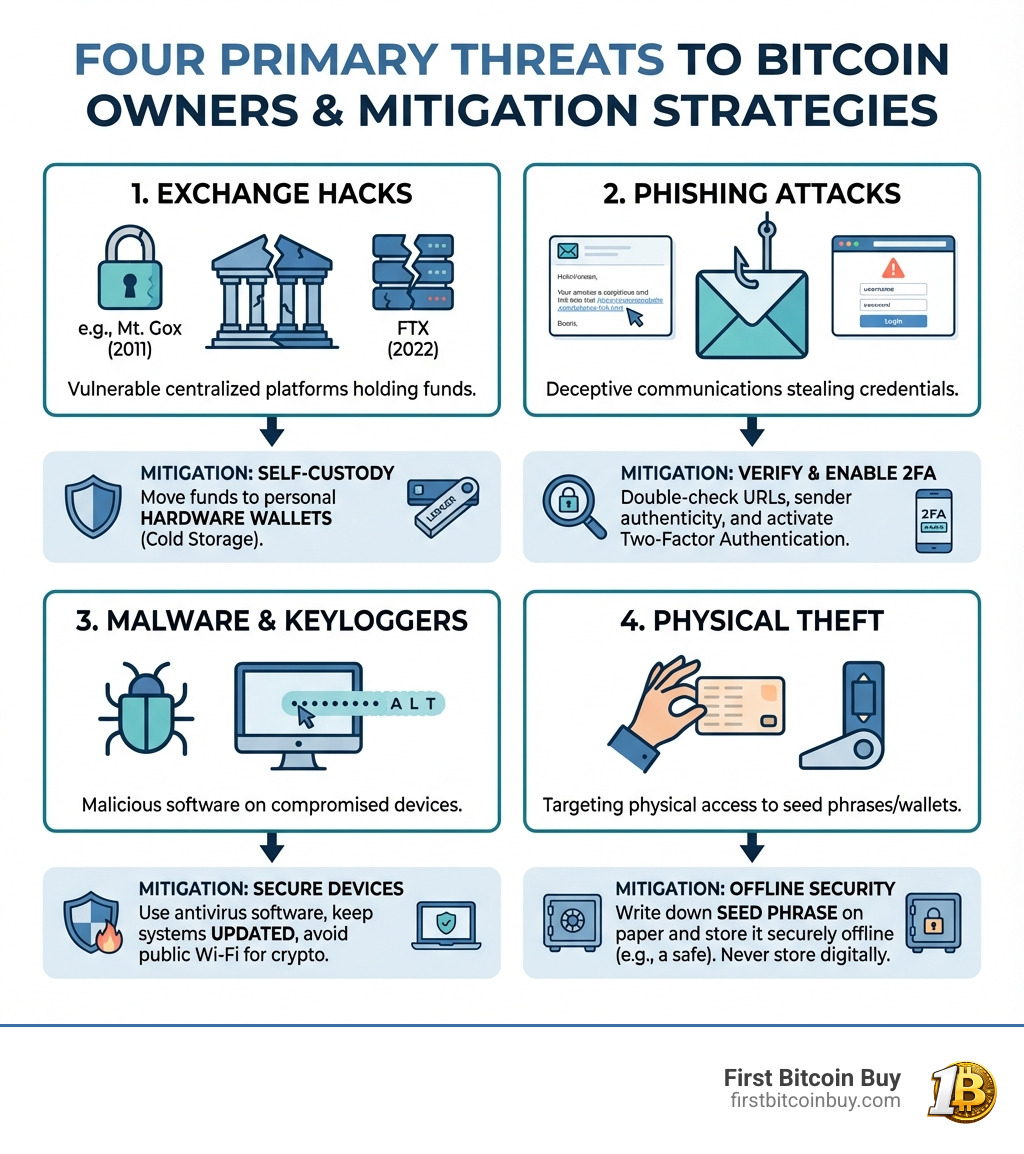
To apply bitcoin safety tips effectively, you must understand the threats. The crypto world differs from traditional finance; Bitcoin transactions are final and irreversible. If your Bitcoin is stolen, it’s likely gone for good. Because you are your own bank, there’s no central authority to help if things go wrong. Primary risks include:
- Exchange Risks: Exchanges can be hacked (Mt. Gox) or collapse (FTX). Leaving Bitcoin on an exchange means trusting a third party with your assets, creating a “counterparty risk” where your funds could be lost if they fail.
- Third-Party Custody Dangers: Any service holding your private keys (custodial wallets) carries similar risks. You are not in control and lack the robust protections of regulated banks.
- Phishing Scams: Scammers use fake emails and messages to trick you into revealing sensitive information like login credentials.
- Social Engineering Tactics: Scammers manipulate you into divulging confidential information, often by impersonating support staff or creating a false sense of urgency.
- Fake Wallet Apps: Scammers create fake wallet apps to steal your funds. They may even appear in app stores or search engine ads.
- Malware and Keyloggers: Infected devices can have software that records keystrokes or steals private keys directly, a major threat to hot wallets.
- SIM-Swapping Attacks: Criminals trick your phone carrier into transferring your number to their SIM card. They can then intercept SMS-based 2FA codes to access your accounts.
Understanding these threats is the first step in implementing effective bitcoin safety tips. For more information on avoiding scams, you can refer to the Federal Trade Commission’s guide: What To Know About Cryptocurrency and Scams | Consumer Advice. We’ve also detailed common mistakes beginners make in our More info about common mistakes guide.
Protecting Yourself on Exchanges and Trading Platforms
Most people start on an exchange, but they are for trading, not long-term storage. Follow the “Get In, Get Out” principle: after buying Bitcoin, move it to a personal wallet where you control the keys. Exchanges are not banks; they lack the same protections. If they are hacked or go bankrupt, your funds are at risk. Limit the time your Bitcoin stays on an exchange.
When using an exchange, here are some critical bitcoin safety tips:
- Strong, Unique Passwords: This is non-negotiable. Every crypto-related account needs a unique, complex password.
- Password Managers: To manage complex passwords and avoid reuse, we highly recommend using a reputable password manager.
- Two-Factor Authentication (2FA): Always enable 2FA. While SMS-based 2FA is better than nothing, authenticator apps (like Google Authenticator) or hardware security keys (like YubiKey) offer much stronger protection.
How to Spot and Avoid Common Scams
Scammers’ tactics evolve, but being vigilant is your best defense. Here are key bitcoin safety tips to avoid common scams:
- Recognizing Phishing Emails: Be wary of emails with unfamiliar senders, spelling errors, or urgent calls to action. Never click links or open attachments in suspicious emails.
- Verifying Website URLs: Double-check website URLs. Scammers create convincing fake sites to steal your credentials. Bookmark official sites and use them.
- Avoiding Suspicious Giveaways: If a giveaway sounds too good to be true, it is. Legitimate companies don’t ask for an upfront payment to receive a prize.
- Downloading Legitimate Software: Only download wallet software from the developer’s official website. Avoid ads on search engines, as they can lead to fake apps. Official sites usually link directly to their mobile apps.
- Using Official Sources Only: Stick to official, well-vetted sources for wallets, exchanges, and information. Do your research before trusting any platform.
For more information on securing your accounts and transactions, check out our dedicated guide on More info about security.
Your Digital Fortress: Mastering Cryptocurrency Wallets
The heart of bitcoin safety tips lies in mastering cryptocurrency wallets. A wallet doesn’t hold your Bitcoin; it holds the cryptographic keys needed to access it on the blockchain. It’s a digital key ring for your assets.
Ownership is secured by a pair of cryptographic keys:
- Public Key: Like a bank account number, this generates your public address for receiving Bitcoin.
- Private Key: This is your secret password and proof of ownership. It signs transactions and provides access to your Bitcoin. Whoever has the private key controls the coins.
The importance of self-custody cannot be overstated. When you control your private keys with a personal wallet, no third party can freeze or seize your assets. This embodies the “Not your keys, not your coins” principle.
There are two main wallet categories:
- Custodial Wallets: Managed by a third party (like an exchange) that holds your private keys. They are convenient but introduce third-party risk from hacks or regulation.
- Non-Custodial Wallets: You store your own private keys, eliminating third-party risk. This is the essence of self-custody and is far more secure.
Hot Wallets vs. Cold Wallets: Which is More Secure?
The distinction between hot and cold wallets is paramount and revolves around internet connectivity.
- Hot Wallets: These are software wallets (desktop, mobile, web) that run on internet-connected devices.
- Internet Connectivity Risks: Being always online makes them vulnerable to malware and hacking. A compromised device means a compromised wallet.
- Best for Small Amounts/Daily Use: Their convenience makes them ideal for small amounts of Bitcoin for frequent transactions, like cash in your physical wallet.
- Cold Wallets: Also known as cold storage, these wallets are kept offline. They include hardware wallets and paper wallets.
- Offline Security Benefits: Keeping private keys offline makes them immune to online threats like malware and remote hacking.
- Best for Long-Term Storage: Cold storage is the gold standard for securing large amounts of Bitcoin for long-term holding (HODLing), like savings in a vault.
Here’s a quick comparison of different wallet types:
For any substantial amount of Bitcoin, we strongly advocate for cold storage. Only keep small, spendable amounts in a hot wallet.
Hardware Wallets: The Gold Standard for Self-Custody
A hardware wallet is an indispensable tool for serious Bitcoin security. It’s a physical device designed to store your private keys securely offline.
Here’s why they’re so effective:
- How They Protect Private Keys: Private keys are generated and stored in a secure, isolated chip on the device. Transactions are signed internally, so the private key never leaves the device and is never exposed to your computer.
- Offline Transaction Signing: The device signs transactions while disconnected from the internet. Even if your computer has malware, your private keys remain safe because they are never online.
- PIN Code Protection: A PIN code protects against physical theft. Most devices wipe themselves after several incorrect PIN attempts.
- Physical Theft Risk Mitigation: The combination of a PIN and offline storage makes theft difficult. If your device is lost or stolen, you can recover your funds with your seed phrase on a new device. As a precaution, move your funds to a new wallet immediately if you lose your device.
Reputable hardware wallets like Ledger or Trezor are a worthwhile investment for securing any significant amount of Bitcoin. Always buy directly from the manufacturer to avoid tampered devices.
The Keys to the Kingdom: Securing Your Seed Phrase
Your seed phrase is the master key to your Bitcoin wallet. Securing it is one of the most critical bitcoin safety tips.
A seed phrase (or recovery phrase) is a list of 12 or 24 words that acts as a master backup for your wallet. If you lose your device, this phrase is the only way to recover your Bitcoin.
- Role in Wallet Recovery: The seed phrase regenerates all your private keys and addresses. It’s your ultimate backup.
- Why You Should Never Store It Digitally: A golden rule: NEVER store your seed phrase digitally. That means no screenshots, photos, cloud storage, or digital notes. A digital copy is vulnerable to hackers. If a hacker gets your seed phrase, they get all your funds.
Best Practices for Backing Up Your Recovery Phrase
Your seed phrase backup must be robust. These bitcoin safety tips for seed phrase storage are non-negotiable:
- Writing It on Paper: At a minimum, write your seed phrase on paper in the correct order.
- Storing in Multiple Secure Locations: Create multiple copies and store them in geographically separate, secure locations (e.g., a home safe and a bank deposit box). This protects against fire, flood, or theft.
- Fireproof and Waterproof Bags: Protect paper backups from damage by using waterproof and fireproof bags.
- Metal Seed Storage Solutions: For maximum durability against fire and water, use a metal storage solution to stamp or engrave your seed words. You can find reviews at Metal Bitcoin Seed Storage Reviews.
- Plausible Deniability with Passphrases (BIP39): For advanced security, add an optional passphrase (the “25th word”) to your seed. This creates a separate, hidden wallet. If a thief gets your 24-word seed, they can’t access the funds in the passphrase-protected wallet. Remember to back up the passphrase as securely as the seed itself, as both are needed for recovery.
The Role of Encryption and Passwords
Encryption and strong passwords play a vital role in everyday bitcoin safety tips.
- Wallet File Encryption: Software wallets encrypt the file containing your private keys with a password. An attacker needs both the file and the password to access your funds.
- Using Strong, Unique Passwords: Use a strong, unique password (16+ characters with letters, numbers, and symbols) for your wallet. Use a password manager.
- Why a Strong Password Matters Against Brute-Force Attacks: A weak password can be easily cracked by brute-force attacks. A strong, complex password makes this exponentially harder, buying you invaluable time and security. A 12-word seed phrase, for example, is practically uncrackable by brute force.
Advanced Bitcoin Safety Tips and Best Practices
Once you’ve mastered the basics, explore these advanced bitcoin safety tips to further secure your assets.
- Two-Factor Authentication (2FA) Methods: Always use 2FA. Prioritize hardware keys (YubiKey) or authenticator apps over SMS-based 2FA, which is vulnerable to SIM-swapping.
- Multisignature (Multisig) Wallets: These advanced wallets require multiple keys to authorize a transaction (e.g., 2 of 3). This eliminates a single point of failure and is ideal for large holdings or shared funds, though it is more complex to set up.
- DeFi Application Risks: Interacting with Decentralized Finance (DeFi) apps can expose your wallet to smart contract vulnerabilities, even with a hardware wallet. Be extremely cautious and only use audited, well-established platforms.
- Regular Security Audits: Security is an ongoing process. Periodically check your hardware wallets, verify your seed phrase backups are intact and legible, and keep all software updated.
Essential bitcoin safety tips for Mobile and Public Wi-Fi
Mobile devices and public Wi-Fi introduce potential risks.
- Risks of Public Wi-Fi: Avoid using public Wi-Fi for crypto transactions. Your traffic can be intercepted, making you a target.
- Man-in-the-Middle (MITM) Attacks: On public Wi-Fi, hackers can position themselves between you and the internet to steal data.
- Benefits of Using a VPN: A Virtual Private Network (VPN) encrypts your internet connection, hiding your activity from snoopers on public Wi-Fi. Use a reputable VPN for all crypto-related activity.
- Securing Your Home Network: Secure your home Wi-Fi with a strong, unique router password, WPA3 encryption, and updated firmware. Use a firewall and anti-malware software on your devices.
- Updating Software Regularly: Keep all software updated: your OS, browser, antivirus, and wallet software/firmware. Updates contain critical security patches that protect against new vulnerabilities.
Long-term bitcoin safety tips: Inheritance and Audits
Thoughtful long-term planning is a key component of comprehensive bitcoin safety tips.
- Creating a Bitcoin Inheritance Plan: Without a plan, your Bitcoin could be lost forever if you pass away. Create a detailed inheritance plan documenting wallet locations, seed phrases, and instructions for your heirs.
- Importance of Clear Instructions for Heirs: Your plan must be clear and accessible to your designated heirs. Consider tools like a dead man’s switch to release information automatically.
- Regularly Checking Backups: Periodically check that your seed phrase backups are legible and undamaged in their secure locations.
- Verifying Hardware Wallet Functionality: Occasionally test your hardware wallet and PIN with a small transaction to ensure it’s working correctly.
- Staying Discreet About Your Holdings: Don’t publicly discuss how much Bitcoin you own. This makes you less of a target for scams and physical threats.
Frequently Asked Questions about Bitcoin Security
We know that navigating Bitcoin security can bring up many questions. Here are some of the most common ones we encounter:
What is the absolute safest way to store Bitcoin?
The safest way to store the bulk of your Bitcoin is in a non-custodial, air-gapped hardware wallet (cold storage). This keeps your private keys completely offline. Combine this with a robust seed phrase backup (metal storage in multiple locations) and an optional passphrase. Use a secure mobile wallet only for small, daily amounts.
Can my Bitcoin be stolen even with a strong password?
Yes. A strong password isn’t foolproof. If your device is compromised with malware (like a keylogger), an attacker can capture your password. This is why hardware wallets are critical: they keep your private keys isolated from your internet-connected computer, so even a compromised device can’t access them.
What should I do if I lose my hardware wallet?
Don’t panic. If you lose your hardware wallet, your Bitcoin is safe as long as no one has your PIN and your seed phrase is secure. You can use your securely backed-up seed phrase to restore access on a new device. As a precaution, once you realize the device is missing, use your seed phrase on a trusted device to move your funds to a new wallet immediately.
Conclusion: Take Control of Your Digital Wealth
Navigating Bitcoin requires a proactive approach to security. We’ve explored that the core principles of bitcoin safety tips revolve around self-custody, offline storage, and vigilant security practices. You are the guardian of your digital wealth, and with knowledge and the right tools, you can bulletproof your Bitcoin holdings against a myriad of threats.
Security is not a one-time setup; it’s an ongoing process. It requires continuous learning, regular checks, and an adaptation to new best practices. Here at First Bitcoin Buy, we are committed to guiding beginners through these essential security practices, helping you understand the nuances of owning and protecting your Bitcoin.
By taking control of your private keys and implementing these bitcoin safety tips, you’re not just securing an asset; you’re embracing the ethos of Bitcoin—becoming your own bank.
Ready to take the next step in securing your digital future? Start your journey with our complete Bitcoin Beginner Guide and empower yourself with the knowledge to thrive in cryptocurrency.