

Understanding Bitcoin: The Digital Currency Changing Finance
What is bitcoin? Bitcoin is a digital currency that operates without banks or governments. Instead, it runs on a peer-to-peer network where transactions are verified by computers worldwide and recorded on a public ledger called the blockchain.
Quick Answer:
- Type: First decentralized cryptocurrency
- Created: 2009 by anonymous creator “Satoshi Nakamoto”
- Supply: Limited to 21 million coins total
- How it works: Peer-to-peer network secured by cryptography
- Key feature: No central authority controls it
- Smallest unit: Satoshi (0.00000001 BTC)
You’ve probably heard about Bitcoin in the news, seen it mentioned by friends, or watched its price swing dramatically. Maybe you’re curious but also cautious—and you should be. The cryptocurrency world can feel overwhelming, filled with technical jargon and stories of both overnight millionaires and devastating scams.
This guide cuts through the noise. We’ll explain exactly what Bitcoin is, how it actually works, and why it matters—all in plain English.
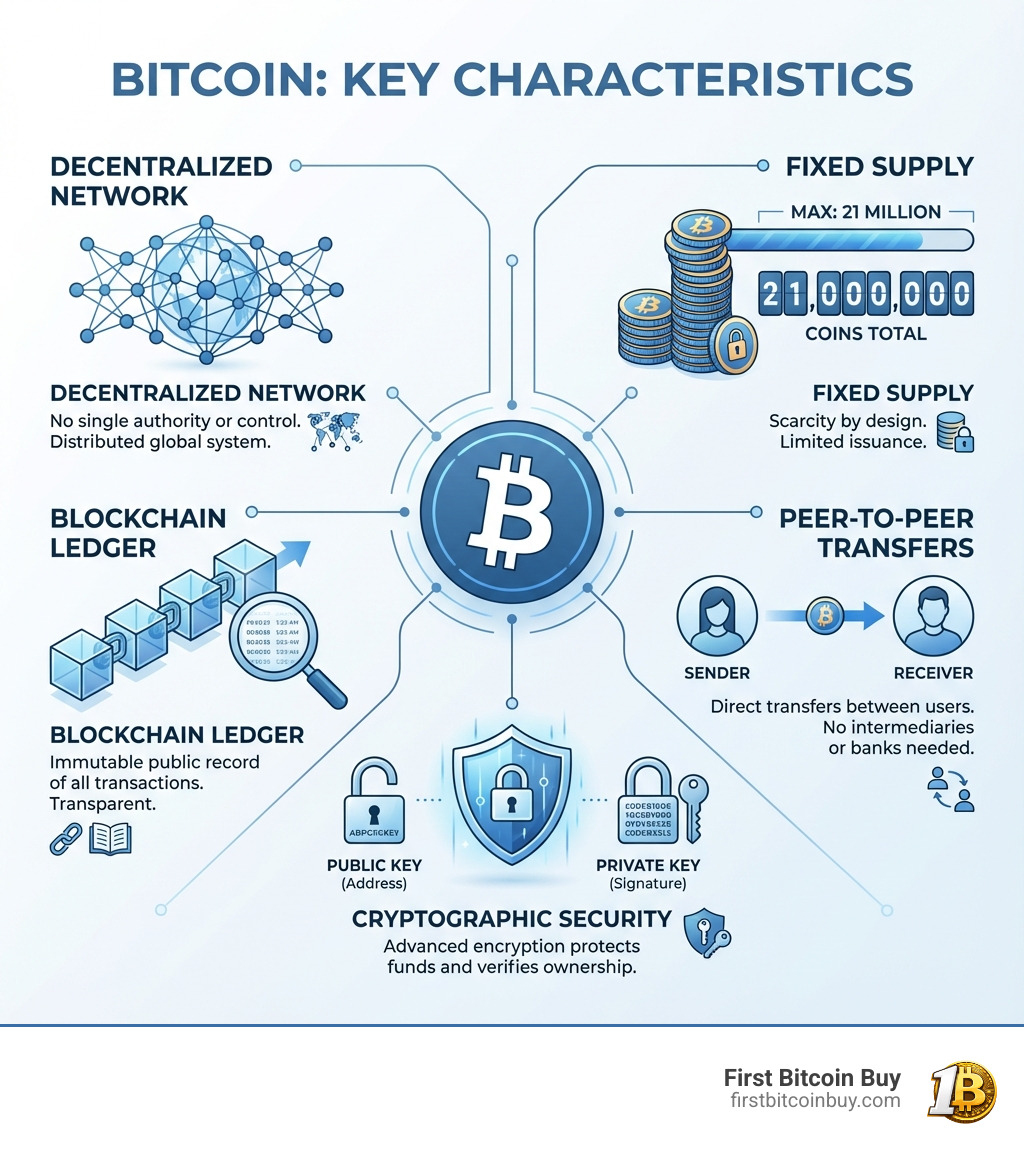
Bitcoin represents a fundamental shift in how we think about money. Unlike dollars or euros that governments can print at will, Bitcoin has a fixed supply of 21 million coins. It’s not controlled by any bank, company, or country. Instead, it’s maintained by a global network of computers that work together to process transactions and secure the system.
The genesis block—Bitcoin’s first transaction—was mined on January 3, 2009, and contained a headline from The Times: “Chancellor on brink of second bailout for banks.” This wasn’t random. It was a statement about Bitcoin’s purpose: to create an alternative to traditional financial systems.
I’m Randy Speckman, and I’ve spent years helping people understand what is bitcoin and how to steer the cryptocurrency space safely. My goal is to empower you with the knowledge to make informed decisions about Bitcoin without falling victim to common pitfalls.
The Fundamentals: What is Bitcoin and How Does it Work?
At its core, what is bitcoin? It is a peer-to-peer electronic cash system designed to allow online payments to be sent directly from one party to another without going through a financial institution. Imagine sending money across the globe instantly, with minimal fees, and without asking a bank for permission. That’s the power of Bitcoin. It’s a digital cash system, built on a decentralized network, meaning no single entity holds the reins. Instead, it’s powered by its users, collectively managing the network.
This concept was laid out in a 2008 white paper by the pseudonymous Satoshi Nakamoto, titled “Bitcoin: A Peer-to-Peer Electronic Cash System,” which proposed solving the “double-spending problem” (preventing digital currency from being spent more than once) using a peer-to-peer network. This system relies on advanced cryptography, using public and private keys to secure transactions and verify ownership.
Who invented Bitcoin and when?
The creation of what is bitcoin is shrouded in mystery. Bitcoin was invented by an anonymous individual or group known as Satoshi Nakamoto, who introduced the concept in a white paper on October 31, 2008. The network came to life on January 3, 2009, when Nakamoto mined the first block, the “genesis block.”
Embedded within this block was the text, “The Times 03/Jan/2009 Chancellor on brink of second bailout for banks.” This message was a subtle commentary on the instability of traditional finance during the global financial crisis, highlighting Bitcoin’s purpose as an alternative. Satoshi Nakamoto guided the project until late 2010 before disappearing, leaving the open-source software to a global community of developers. To this day, their identity remains unknown, reinforcing Bitcoin’s decentralized, leaderless nature.
What is blockchain technology and how does it relate to Bitcoin?
Blockchain technology is the backbone of what is bitcoin. Think of it as a digital, distributed public ledger that records all Bitcoin transactions. Instead of a single bank keeping a record, this ledger is maintained across thousands of computers (nodes) worldwide.

Here’s how it works:
- Blocks: Transactions are grouped into “blocks.”
- Chain: These blocks are cryptographically linked in a chronological “chain,” creating an immutable history of all transactions. Once a block is added, it’s incredibly difficult to alter.
- Distributed: Copies of the blockchain are held by participants across the network. This decentralization means there is no single point of failure and no central authority can censor transactions.
This structure ensures transparency and security. Anyone can view the transactions, yet participants remain pseudonymous. As The Economist aptly put it, blockchain is “The great chain of being sure about things.” It’s this technology that allows Bitcoin to operate as a trustless system, where users trust the cryptographic rules of the network rather than an intermediary.
What is Bitcoin mining and how are transactions validated?
Bitcoin mining is the process that keeps the network secure, verifies transactions, and introduces new bitcoins into circulation. It’s a crucial component of what is bitcoin, ensuring its integrity.
Miners use powerful computers to solve complex mathematical puzzles in a process called “proof-of-work.” They bundle pending transactions into a new block and compete to be the first to solve the puzzle associated with it. The winner adds the block to the blockchain and is rewarded with newly created bitcoins (the “block reward”) and transaction fees.
As of the 2024 halving, the block reward is 3.125 BTC. This reward is designed to decrease over time, occurring approximately every four years to control the issuance of new coins and maintain scarcity.
This competitive process serves several vital functions:
- Transaction Validation: It confirms pending transactions are legitimate and prevents double-spending.
- Network Security: The immense computational power required makes it extremely difficult for a malicious actor to alter the blockchain (known as a “51% attack”).
- Consensus Mechanism: Mining enforces chronological order and ensures all nodes on the network agree on the state of the ledger.
Mining acts as a decentralized data center, securing the network and issuing new bitcoins according to a predictable schedule.
Bitcoin vs. Traditional Money: A New Financial Paradigm
Understanding what is bitcoin means recognizing how it fundamentally differs from the traditional money we use every day. Our “normal” money, often called fiat currency (like the US dollar), is issued and controlled by central banks and governments. Its value is backed by trust in the issuing authority. Bitcoin, however, operates under a completely different paradigm.
| Feature | Bitcoin | Fiat Currency (e.g., USD) |
|---|---|---|
| Issuer | Decentralized network (miners) | Central banks, governments |
| Supply | Fixed (21 million total) | Potentially unlimited (can be printed at will) |
| Transparency | All transactions public on blockchain | Centralized, often opaque |
| Control | Peer-to-peer, user-controlled | Government and financial institutions |
How is Bitcoin different from traditional money?
The differences are stark. First, Bitcoin has no central bank or government controlling it, meaning no single entity can freeze funds or reverse transactions. This contrasts with traditional money, which, as Investopedia notes, often lacks inherent value, much like fiat currencies did after leaving the gold standard.
Second, and perhaps most crucially, Bitcoin has a finite supply of 21 million coins. This scarcity is a core design principle and a built-in defense against the inflation that can erode the purchasing power of traditional currencies when governments print more money.
Third, Bitcoin is digital by nature. It was born digital and exists solely on the internet, secured by cryptographic proofs. This allows for user autonomy, giving individuals direct control over their funds without intermediaries.
What are the units of Bitcoin and why would you use it?
While we often talk about “one Bitcoin,” it’s highly divisible, making it practical for transactions of all sizes. The smallest unit is a satoshi (sat), which is one hundred millionth of a bitcoin (0.00000001 BTC). This divisibility ensures that even if Bitcoin’s value increases significantly, it can still be used for small purchases.
So, why would someone want to use what is bitcoin instead of traditional currency?
- Lower Fees for International Transfers: Bitcoin can offer significantly lower fees for sending money globally compared to traditional banking systems.
- Censorship Resistance: Because it’s decentralized, transactions cannot be easily censored or blocked, which is appealing in regions with strict capital controls.
- Store of Value: Many view Bitcoin as “digital gold” due to its fixed supply, believing it can preserve value over time better than fiat currencies.
- Payment Freedom: Bitcoin allows you to send and receive payments anywhere in the world, at any time, without borders or bureaucracy. You are in full control of your money.
For those ready to explore this new financial paradigm, we can guide you on how to get started with Bitcoin safely and securely. Learn how to get started with Bitcoin.
What are the environmental concerns?
The environmental footprint of what is bitcoin mining is a significant topic. The “proof-of-work” mechanism requires substantial computational power, which translates to considerable energy consumption.
Critics highlight that the mining system is energy-hungry. The University of Cambridge’s online calculator tracks Bitcoin’s energy use, which has been compared to that of entire countries. This demand raises concerns about carbon emissions, depending on the energy sources used.
However, the narrative is evolving:
- Shift to Renewables: Many mining operations are increasingly turning to renewable energy sources like hydro, solar, and wind power, particularly in the United States, which has become a major hub for Bitcoin mining.
- Efficiency Improvements: Mining hardware is becoming more energy-efficient, with specialized chips (ASICs) designed for greater power efficiency.
- E-waste from Mining Hardware: Another concern is the electronic waste from outdated mining hardware. As new, more efficient machines are developed, older equipment becomes obsolete.
Proponents argue that the energy used to secure a global, decentralized financial network is a worthwhile trade-off, but the debate emphasizes the need for continued innovation in sustainable mining practices.
Investing in Bitcoin: Opportunities, Risks, and How to Start
For many, what is bitcoin isn’t just a currency; it’s an investment asset, often called “digital gold.” Its unique characteristics have positioned it as a potential tool for portfolio diversification, attracting both individual and institutional investors. However, it comes with its own set of opportunities and risks, making it a high-risk, high-reward proposition.
What are the main benefits and risks of investing in Bitcoin?
Investing in what is bitcoin can be an exciting journey, but it’s crucial to understand both the potential upsides and the inherent downsides.
Benefits of Investing in Bitcoin:
- High Return Potential: Bitcoin has historically shown significant price appreciation, attracting investors seeking substantial returns. For example, its price jumped from around $7,167 in December 2019 to over $28,984 by December 2020.
- Inflation Hedge: Due to its fixed supply of 21 million coins, many investors view Bitcoin as a hedge against the inflation that can devalue fiat currencies.
- Accessibility: Bitcoin markets operate 24/7 and are accessible to anyone with an internet connection, breaking down geographical barriers to investment.
- Institutional Interest: Major financial institutions and corporations (like MicroStrategy and MassMutual) have shown interest by investing in Bitcoin or offering related products. BlackRock, for instance, has discussed portfolio allocations for interested investors.
Risks Associated with Investing in or Using Bitcoin:
- Price Volatility: Bitcoin is notoriously volatile. Its price can swing dramatically in short periods. For instance, after hitting a high of nearly $69,000 in November 2021, it fell below $16,000 by November 2022.
- Regulatory Uncertainty: The regulatory landscape for cryptocurrencies is still evolving globally. Future regulations could significantly impact Bitcoin’s value and use.
- Security Threats: While the Bitcoin network is secure, user error and hacks of crypto platforms can lead to irreversible losses. It’s estimated that a significant percentage of all Bitcoins are lost forever, often due to misplaced private keys.
- Scams and Fraud: The crypto space can be a target for scams, from phishing attacks to fraudulent schemes. It’s crucial to be vigilant and informed.
- Lack of Recourse: Unlike traditional banking, there’s no central authority to reverse transactions or recover funds if you make an error or are a victim of theft.
We believe that education is the best defense against these risks. For a deeper dive into responsible crypto investing, check out our complete Bitcoin Beginner Guide.
How can you buy, sell, and store Bitcoin?
If you’re ready to take the plunge and buy what is bitcoin, we’re here to guide you through the process safely.
Here’s a simplified breakdown of how one can buy or sell Bitcoin:
- Choose a Trusted Platform: Select a reputable cryptocurrency platform that operates in the United States. Consider factors like security, fees, and user-friendliness.
- Create an Account: Sign up and complete the identity verification (KYC) process to comply with financial regulations.
- Fund Your Account: Deposit funds by linking a bank account or using a debit card.
- Place Your Order: Go to the Bitcoin trading section, specify the amount you want to buy, and place your order. The Bitcoin will then appear in your platform wallet.
For first-time buyers, we recommend starting with platforms known for their beginner-friendly approach. We specialize in helping you purchase Bitcoin on Coinbase, providing step-by-step instructions focused on security. If you’re ready, we have more info about getting started with Bitcoin.
Converting Bitcoin to Cash: Yes, Bitcoin is convertible. You can sell it on the same platforms where you bought it, converting it back into US dollars for withdrawal to your bank account.
Storing Bitcoin:
- Hot Wallets: These are connected to the internet (e.g., exchange accounts, mobile apps). They are convenient but less secure for large amounts.
- Cold Wallets: These are offline storage solutions, like hardware wallets (physical devices), that are much more secure against online theft.
What is a Bitcoin ETF and what are the tax implications?
A Bitcoin ETF (Exchange-Traded Fund) is an investment fund that tracks the price of Bitcoin. In the US, spot Bitcoin ETFs began trading in January 2024, allowing investors to gain exposure to Bitcoin through traditional brokerage accounts without directly owning the cryptocurrency.
Are Bitcoin ETFs regulated? Yes, Bitcoin ETFs are regulated financial products overseen by agencies like the SEC in the United States. This oversight makes them an attractive option for those seeking a more conventional investment pathway.
Tax Implications of Investing in Bitcoin ETFs within IRAs:
The IRS treats cryptocurrencies as property for tax purposes. Selling Bitcoin or a Bitcoin ETF for a profit is generally subject to capital gains tax.
However, investing in a Bitcoin ETF within an Individual Retirement Account (IRA) can offer significant tax advantages:
- Traditional IRA: Grow your investment tax-deferred, paying taxes only upon withdrawal in retirement.
- Roth IRA: Contributions are made with after-tax dollars, but qualified withdrawals in retirement are tax-free.
This allows investors to potentially benefit from Bitcoin’s growth while minimizing or deferring tax liabilities. Always consult with a qualified tax professional for personalized advice.
The Future and Regulation of Bitcoin
The journey of what is bitcoin has been dynamic, marked by rapid evolution, shifting regulations, and growing mainstream adoption. The future promises continued change and debate.
What is the current regulatory landscape for Bitcoin?
In the United States, the regulatory landscape for Bitcoin is still taking shape. The IRS treats Bitcoin as property, subject to capital gains taxes, while agencies like the SEC and FINRA have issued investor alerts about risks. The approval of spot Bitcoin ETFs in the US in January 2024 was a major regulatory step, integrating Bitcoin more closely with traditional financial markets.
Globally, regulations vary widely. El Salvador made headlines by adopting Bitcoin as legal tender in September 2021, though this remains an exception. Some US states and international cities have begun accepting crypto for taxes or municipal payments. The overall trend in the US is towards creating a clearer regulatory framework rather than an outright ban.
What is the future outlook for Bitcoin?
The future outlook for what is bitcoin is a topic of intense speculation and optimism for many.
- Technological Upgrades: The Bitcoin network continues to evolve. Upgrades like Taproot (activated in 2021) aim to improve privacy, efficiency, and smart contract capabilities.
- Scaling Solutions: To address transaction speed and costs, “Layer 2” solutions like the Lightning Network are being developed. These aim to handle more transactions off the main blockchain, making Bitcoin more viable for everyday payments.
- Increased Adoption: Adoption by businesses and individuals continues to grow. Major companies have added Bitcoin to their balance sheets, and payment processors have enabled crypto transactions for millions of users. Globally, the number of Bitcoin users is estimated to be in the tens of millions and is steadily increasing.
- Institutional Interest: The launch of spot Bitcoin ETFs in the US has opened the door for more institutional capital, which could increase its legitimacy as an asset class and potentially stabilize its price over the long term.
While debates about its volatility and environmental impact will continue, the trajectory suggests a growing integration of Bitcoin into the global financial system. The conversation is shifting from “if” Bitcoin will be relevant to “how” it will shape the future of finance.
Conclusion
We’ve journeyed beyond the buzz to explore what is bitcoin at its foundational level. We’ve seen that it’s more than just digital money; it’s a groundbreaking peer-to-peer electronic cash system, built on the blockchain technology. It operates without central control, offering a fixed supply that stands in stark contrast to traditional inflationary currencies. From its mysterious origins with Satoshi Nakamoto to its complex mining process that secures its network, Bitcoin represents an innovative approach to finance.
While it offers exciting benefits like high return potential, inflation hedging, and global accessibility, we also acknowledge the inherent risks, including price volatility, regulatory uncertainty, and security concerns. We believe that understanding these aspects is key to navigating the crypto space wisely.
Bitcoin continues to evolve, with technological upgrades and scaling solutions paving the way for broader adoption. The increasing institutional interest and a maturing regulatory landscape in the US indicate its growing role in the global financial ecosystem.
At First Bitcoin Buy, our mission is to empower you to understand and safely participate in this digital revolution. We guide first-time buyers through the process, focusing on security and avoiding common pitfalls.
Ready to confidently step into digital currency? Download our free Bitcoin Beginner Checklist to start your journey safely.