
Why Your First Bitcoin Purchase Amount Matters More Than You Think
How much Bitcoin should I buy first is the most common question from newcomers, and the answer is simpler than most people expect. Here’s what experts and institutions recommend:
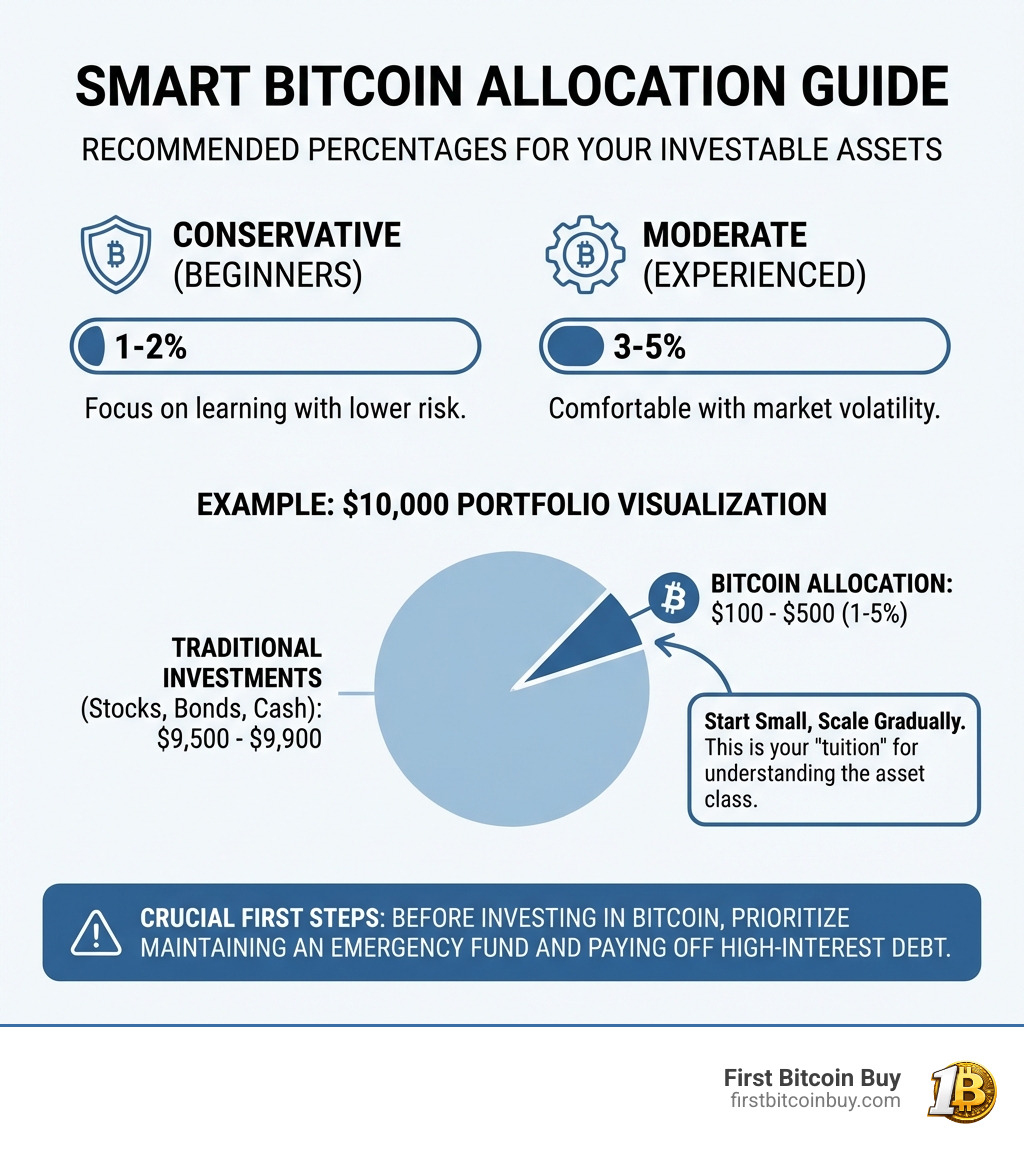
Quick Answer: Start with 1-5% of your investable assets
- Ultra-Conservative: 1-2% (recommended by BlackRock and Goldman Sachs)
- Moderate: 3-5% (for those comfortable with volatility)
- Absolute Beginner: $50-$100 (to learn without significant risk)
Key Rule: Only invest money you can afford to lose entirely
Few things capture an investor’s imagination like Bitcoin, especially when stories of six-figure profits flood social media. But here’s the truth most people miss: the amount you invest matters more than the timing. Bitcoin’s weekly price movements commonly swing 10-20%, which means your investment size directly impacts your emotional ability to stay the course.
Most financial advisors recommend limiting Bitcoin to 1-5% of your portfolio precisely because of this volatility. Start too large, and a 30% price drop (which happened in late 2025) might trigger panic selling. Start too small, and you won’t build the real-world experience needed to understand this new asset class.
The sweet spot for beginners? Between $50 and $500, deployed gradually through regular purchases. This “tuition money” approach lets you learn Bitcoin’s mechanics—wallets, security, price discovery—without risking funds needed for rent or emergencies.
I’m Randy Speckman, and I created First Bitcoin Buy after helping hundreds of newcomers navigate their first purchase. Through years of guiding people on how much Bitcoin should I buy first, I’ve learned that measured steps and informed decisions matter far more than perfect timing.
How Much Bitcoin Should I Buy First?

When we sit down to figure out how much bitcoin should i buy first, the conversation usually shifts from “How much can I make?” to “How much can I comfortably watch fluctuate?” Bitcoin isn’t a traditional stock; it’s a decentralized digital asset with a fixed supply cap of 21 million coins. This scarcity is what drives its value, but it also creates a global, 24/7 trading environment where prices can evolve rapidly.
The consensus among top-tier financial institutions has shifted significantly in recent years. For instance, BlackRock recommending a 1-2% allocation has become a benchmark for conservative entry. Even Goldman Sachs maintains over $470 million in direct Bitcoin holdings, signaling that even the “big players” see it as a necessary part of a modern portfolio, albeit in controlled amounts.
Your personal starting point depends on your “investable assets”—the money you have left over after your bills are paid and your emergency fund is tucked away. If you have $2,000 in total savings intended for investment, a 1% to 5% allocation means your first purchase should be between $20 and $100. This ensures that even if Bitcoin takes a major dip, your financial foundation remains unshaken.
| Allocation Style | Percentage | Example ($10,000 Portfolio) | Risk Level |
|---|---|---|---|
| Ultra-Conservative | 1% | $100 | Low |
| Institutional Standard | 2% | $200 | Moderate-Low |
| Moderate | 5% | $500 | Moderate |
| Aggressive Beginner | 10% | $1,000 | High |
For more detailed breakdowns on sizing your entry, check out our guide on How Much to Buy.
Is $100 the Right Amount of Bitcoin to Buy First?
Many of our readers ask if a small amount like $100 is even worth the effort. The answer is a resounding yes. Think of your first $100 as “tuition money.” It’s the price you pay to learn how the market moves, how to use an exchange like Coinbase, and how it feels to own a piece of the future.
You don’t need to buy a whole Bitcoin. Thanks to “fractional shares,” you can buy tiny pieces called “Satoshis” (or “sats”). One Bitcoin is divisible into 100 million sats. When you buy $100 worth of Bitcoin at a $50,000 price point, you are securing 200,000 sats (0.002 BTC). This allows you to participate in the upside without needing tens of thousands of dollars. You can learn more about entry-level limits in our article on Minimum Bitcoin Purchase.
Factors Determining How Much Bitcoin You Should Buy First
Before you hit the “buy” button, we recommend a quick financial audit. Bitcoin should never come at the expense of your daily life.
- Disposable Income: Only use money that isn’t earmarked for rent, groceries, or insurance.
- Emergency Fund: Do you have 3-6 months of living expenses in a standard bank account? If not, build that first.
- Debt Management: If you have credit card debt with 20% interest, paying that off is a “guaranteed return” that should usually happen before buying volatile assets.
- Time Horizon: Bitcoin is a marathon, not a sprint. If you need the money back in six months for a wedding or a car, the volatility might work against you.
- Financial Goals: Are you looking for a long-term store of value (like “Digital Gold”) or a speculative short-term trade? Most beginners find success with the former.
Strategic Approaches for Starting Small
Once you’ve settled on a total budget, the next question is how to spend it. Should you dump it all in at once (Lump Sum) or spread it out? We strongly advocate for a “start small and scale” strategy.
Regular, systematic buying helps mitigate the impact of short-term volatility and reduces timing risk. This is known as Dollar-Cost Averaging (DCA). Instead of trying to guess if Bitcoin is at a “low” today, you commit to buying a fixed dollar amount—say $50—every week or month. If you’re ready to take that first step, see our guide on the First 50 Dollars.
The Power of Recurring Purchases
Automation is a beginner’s best friend. Most exchanges, especially Coinbase, allow you to set up recurring purchases. This removes the “emotional” element of investing. When the price is high, your $50 buys a smaller amount of Bitcoin. When the price crashes (and it will), your $50 buys more Bitcoin. Over time, this often results in a lower average cost basis than trying to time the market perfectly.
Consistency beats intensity every time. A beginner who allocated $500 per month from January 2022 to December 2024 (totaling $18,000 invested) saw their portfolio reach $51,929 in total value by the end of that period. That’s the power of staying disciplined through the dips.
Lump Sum vs. DCA for Beginners
While research indicates that lump sum investing outperformed DCA in about 66-68% of scenarios analyzed from 2017 through 2023, that statistic doesn’t account for the “sleep at night” factor.
For a beginner, a lump sum investment can be terrifying. If you put in $1,000 and the price drops 20% the next day, you might panic and sell at a loss. DCA remains preferable for many retail investors prioritizing emotional comfort and risk mitigation. It allows you to build “skin in the game” slowly while you increase your knowledge.
Essential Tools and Security for Your First Purchase
Knowing how much bitcoin should i buy first is only half the battle; you also need to know where to put it. Security is the foundation of everything we teach at First Bitcoin Buy.
We recommend starting with a reputable, U.S.-based exchange like Coinbase. It’s beginner-friendly and provides a familiar interface similar to a banking app. However, security is a shared responsibility. You must enable Multi-Factor Authentication (MFA)—and we suggest using an app like Google Authenticator rather than SMS, which is vulnerable to SIM-swapping scams.
Choosing Between Hot and Cold Storage
When you buy on an exchange, your Bitcoin is in a “hot wallet” (connected to the internet). This is convenient for small amounts, but for anything over a few hundred dollars, you should consider “cold storage.”
- Hot Wallets (Software): Apps on your phone or desktop. Great for accessibility.
- Cold Wallets (Hardware): Physical devices that keep your private keys offline. The Trezor Model T is a popular choice for beginners because of its touchscreen and intuitive setup.
Remember the golden rule of crypto: “Not your keys, not your coins.” If you leave your Bitcoin on an exchange indefinitely, you are trusting that exchange’s security. For long-term savings, moving to a hardware wallet is the ultimate security upgrade.
Avoiding Common Beginner Scams
The irreversible nature of Bitcoin transactions makes it a target for scammers. Between 2023 and mid-2025, over $2.7 billion was lost to crypto hacks. To protect yourself:
- Never share your seed phrase: Your 12 or 24-word recovery phrase is the “key” to your money. No legitimate support person will ever ask for it.
- Beware of “Double Your Money” offers: If an influencer or a DM promises to double your Bitcoin if you send it to them, it is 100% a scam.
- Check the URL: Always ensure you are on the official Coinbase website. Phishing links often look nearly identical to the real thing.
Managing Volatility and Long-Term Growth
Bitcoin is famous for its wild price swings. To succeed, you need to develop emotional resilience. It’s helpful to remember that Bitcoin has a history of recovering from its 2022 drawdown within approximately 12 to 18 months. If you view this as a 5-to-10-year play, the daily “noise” becomes much easier to ignore.
As your portfolio grows, you may need to “rebalance.” If Bitcoin starts at 5% of your portfolio but its price triples, it might now represent 15% of your wealth. This might be more risk than you’re comfortable with, and it may be time to sell a little bit to get back to your original 5% target.
Tax Implications and Record Keeping
In the United States, Bitcoin is treated as property by the IRS. This means every time you sell, trade, or spend Bitcoin, it is a “taxable event.”
Starting in 2025, the introduction of Form 1099-DA for broker-reported sales and exchanges means the government will receive transaction details directly from exchanges. To stay compliant, keep meticulous records of:
- The date you bought the Bitcoin.
- The price you paid (your “cost basis”).
- The date you sold or traded it.
- The price at the time of the sale.
Using tools like CoinLedger or Koinly can automate this process, making tax season much less of a headache.
When to Increase Your Allocation
Once you’ve made your first purchase and survived a few market dips, you might feel ready to increase your investment. We suggest doing this based on “knowledge milestones” rather than price hype.
Ask yourself:
- Do I understand how a hardware wallet works?
- Can I explain the Bitcoin “Halving” to a friend?
- Have I stayed calm during a 10% price drop?
If the answer is yes, you might gradually move from a 1% allocation to a 3% or 5% allocation.
Frequently Asked Questions about Starting with Bitcoin
Is $50 enough to start investing in Bitcoin?
Absolutely. $50 is a fantastic entry point. It allows you to establish the habit of investing and gives you a front-row seat to the market without any financial stress. Many experts suggest beginners start with regular purchases of $10 to $100 to build confidence.
How much Bitcoin do I need to become a millionaire?
This is a popular “moon math” question. If Bitcoin were to reach $1 million per coin (an optimistic scenario discussed by some analysts), you would need 1 full BTC to be a millionaire. However, even owning 0.1 BTC (~$10,000 at current high levels) could result in $100,000 in that same scenario. Focus on steady accumulation rather than overnight riches.
Is Bitcoin a safe investment for beginners?
Bitcoin is a “high-risk, high-reward” asset. While it has seen massive institutional adoption from firms like BlackRock, it remains highly volatile. It is “safe” only if you manage your risk by keeping it to a small percentage of your total wealth and using proper security tools like hardware wallets.
Conclusion
Determining how much bitcoin should i buy first is the most important strategic decision you’ll make in your crypto journey. By starting small—perhaps with just $100 or 1% of your portfolio—you give yourself the room to learn, make mistakes, and grow without risking your financial future.
At First Bitcoin Buy, we believe that security and education are the keys to long-term success. Don’t let the “Fear Of Missing Out” (FOMO) drive your decisions. Instead, rely on a disciplined plan, use a secure exchange like Coinbase, and keep your eye on the long-term horizon.
Ready to take the next step? Start your journey with our Coinbase beginner guide and learn how to make your first purchase safely and confidently.