

Why Understanding Common Bitcoin Mistakes Beginners Make Could Save You Thousands
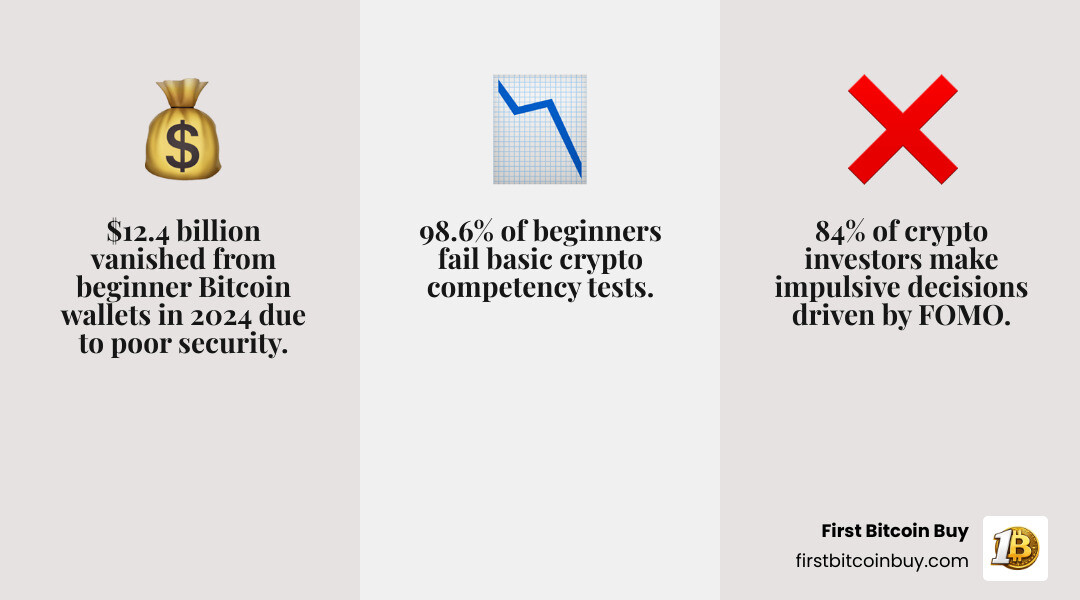
Common bitcoin mistakes beginners make can be devastating—over $12.4 billion vanished from beginner wallets in 2024 alone, and another $2.17 billion disappeared in just the first half of 2025. The good news? Nearly all of these losses were preventable.
The 10 Most Common Bitcoin Mistakes Beginners Make:
- Storing seed phrases digitally instead of on paper or metal
- Leaving Bitcoin on exchanges long-term instead of moving to self-custody
- Buying during FOMO without a clear strategy
- Panic selling during temporary price dips
- Falling for AI-powered scams and phishing attacks
- Overtrading and losing money to excessive fees
- Skipping test transactions before large transfers
- Using weak passwords or reusing them across platforms
- Chasing cheap altcoins instead of focusing on Bitcoin
- Ignoring basic security like two-factor authentication
Research shows that 84% of crypto investors make decisions based on FOMO, and 98.6% of beginners fail basic crypto competency tests. People who follow influencer trades lose an average of 7.9% over 30 days—that’s a 62.8% annual loss rate.
Bitcoin feels exciting and fast, but also unforgiving. For many newcomers, the learning curve includes hard lessons: lost keys, fake apps, panic selling during corrections, and falling for scams that sound too good to be true. A single wrong character in an address can send your funds into an irretrievable void. One forgotten password without a backup can lock you out of your own money forever.
The crypto market operates 24/7 unlike traditional markets, and its volatility is legendary—20% price swings in either direction in a single day aren’t unusual. This environment amplifies every mistake, turning small errors into costly lessons.
But here’s the truth: you don’t need to learn these lessons the hard way.
Most Bitcoin losses stem from preventable errors in three categories: emotional decisions driven by market hype, security failures like poor seed phrase storage, and technical mistakes like choosing the wrong exchange or ignoring fees. The good news is that building careful habits early can help you avoid the pitfalls that have cost other beginners billions.
I’m Randy Speckman, and through First Bitcoin Buy, I’ve guided hundreds of everyday people through their first Bitcoin purchase with confidence and clarity, helping them understand and avoid common bitcoin mistakes beginners make that lead to preventable losses. My focus is on measured steps, informed decisions, and sustainable habits that protect your investment from day one.
Psychological Traps and Common Bitcoin Mistakes Beginners Make

The biggest hurdle for any newcomer isn’t the technology—it’s the person in the mirror. Bitcoin markets are high-octane environments where greed and fear are constantly battling for control of your mouse finger. When we talk about common bitcoin mistakes beginners make, we have to start with the psychology of the “get-rich-quick” mindset.
Statistics show that 84% of crypto investors make decisions based on FOMO. When you see a green candle shooting up on a chart, your brain releases dopamine, making you feel like you’re missing out on the opportunity of a lifetime. This leads to “panic buying” at the top, just before the market corrects.
To succeed, you must learn to regulate your emotions. Successful Bitcoiners treat their stack like a savings account, not a lottery ticket. If you find your heart racing every time you check the price, you’re likely over-leveraged or lack a clear plan. Check out our Bitcoin Beginner Guide: Common Mistakes to see how to build a mental fortress against these psychological traps.
Battling FOMO and Greed
FOMO, or the Fear Of Missing Out, is the primary driver of impulsive decisions. Beginners often see an “influencer” on social media shouting about a coin that is “going to the moon” and rush to buy in without doing their own research (DYOR).
The reality is harsh: research indicates a 7.9% average loss following influencers over just 30 days. That scales to a staggering 62.8% annual loss. These influencers are often paid to promote projects, or they are simply “pumping” their own bags so they can sell to you. Greed makes you blind to the red flags. Before you click “buy,” ask yourself: Am I buying this because I understand its value, or because I’m afraid the price will go up without me?
The Danger of Panic Selling
On the flip side of FOMO is panic selling. Bitcoin is famous for its volatility, and it is perfectly normal to see a 10% or 20% drop in a single week. Beginners who haven’t developed a long-term vision often see these red candles and sell their holdings in a state of terror, “locking in” their losses.
Market cycles are natural. Price corrections are healthy. If you Safely Buy Crypto with the intention of holding for years rather than days, these short-term fluctuations become noise. Remember: you only actually lose money if you sell for less than you paid. By staying calm during dips, you avoid one of the most common bitcoin mistakes beginners fall victim to.
Security Failures: How to Avoid Common Bitcoin Mistakes Beginners Make with Storage
In Bitcoin, you are your own bank. This is incredibly empowering, but it also means there is no “Forgot Password” button if you mess up. Neglecting security measures is how billions of dollars are lost every year. From potential scams and frauds to simple human error, your storage strategy is your first line of defense.
If you are in the US, following Your Guide to Safe Bitcoin Buying in the United States is a great starting point for establishing secure habits.
Protecting Your Seed Phrase and Private Keys
Your seed phrase (usually 12 or 24 words) is the master key to your funds. If someone gets those words, they own your Bitcoin. One of the most heartbreaking common bitcoin mistakes beginners make is taking a screenshot of their seed phrase or saving it in a cloud-based note app.
Hackers use automated scripts to scan for these patterns. A California resident reportedly lost $100,000 simply because they had a photo of their seed phrase on their phone, which was then compromised via a phishing attack. With over $12.4 billion vanished from beginner wallets in 2024, the lesson is clear: Never digitize your seed phrase.
Instead:
- Write it down on physical paper or, better yet, engrave it on a metal backup plate.
- Store it in a fireproof safe or a secure physical location.
- Make a secondary backup and store it in a different physical location (like a family member’s safe).
Avoiding Exchange Custody Risks
When you buy Bitcoin on an exchange like Coinbase, the exchange technically holds the keys. While Coinbase is a highly secure, regulated platform in the US, the gold standard of Bitcoin ownership is self-custody. The phrase “not your keys, not your coins” exists for a reason.
If an exchange goes offline, gets hacked, or freezes your account, you lose access to your money. We often recommend that beginners Buy Bitcoin on Coinbase but Transfer to Another Account—specifically a hardware wallet (cold storage). Cold storage keeps your private keys offline and away from the reach of internet-based hackers. It is the single most effective way to protect your wealth long-term.
Technical and Strategic Pitfalls: Why Common Bitcoin Mistakes Beginners Make Lead to Overtrading
Many beginners treat Bitcoin like a casino game. They see the charts and think they can “beat the market” by trading in and out of positions multiple times a day. This is called overtrading, and it is a recipe for disaster.
Overtrading leads to exhaustion, poor decision-making, and a massive accumulation of fees. If you’re constantly clicking buttons, you’re not an investor; you’re a gambler. Before you dive in, make sure you’ve reviewed Coinbase Signup: Fees Explained so you understand exactly how much each “click” is costing you.
Managing Fees and Exchange Costs
Every time you buy, sell, or swap Bitcoin, the exchange takes a cut. For beginners, these costs can erode profits surprisingly fast. There is the “trading fee” (a flat percentage) and the “spread” (the difference between the buy and sell price).
If you’re wondering How Much Does It Cost to Buy Bitcoin, you have to look beyond the sticker price. Frequent trading can result in hundreds of dollars in lost value annually just from fees alone. Furthermore, in the United States, every single trade is a taxable event. Overtrading doesn’t just hurt your balance; it creates a nightmare for you come tax season.
The Trap of Short-Term Thinking
The potential of compounding is the “eighth wonder of the world,” but it requires time. Beginners often sell too early, missing out on massive long-term gains because they were happy with a 5% profit.
| Strategy | Stress Level | Success Rate (Beginners) | Tax Complexity |
|---|---|---|---|
| Day Trading | High | < 5% | High |
| HODLing (Long-term) | Low | > 90% (historically) | Low |
Instead of trying to time the market, we recommend Dollar-Cost Averaging (DCA). This involves buying a fixed dollar amount of Bitcoin on a regular schedule (e.g., $50 every Friday), regardless of the price. This strategy smooths out volatility and removes the emotional burden of trying to find the “perfect” entry point.
Falling for AI-Powered Scams and Phishing
In 2025, scams have become incredibly sophisticated. AI scams generated $9.9 billion in losses in 2024, accounting for 60% of all scam deposits. These include deepfake videos of celebrities like Elon Musk promising to “double your Bitcoin” if you send it to a specific address.
Remember: No one is giving away free Bitcoin.
Other common tactics include:
- Phishing: Fake emails or websites that look exactly like Coinbase, asking you to “verify your account” by entering your seed phrase.
- Fake Support: Scammers on Telegram or X (Twitter) pretending to be “Coinbase Support” to help you with a transaction.
- URL Verification: Always bookmark your exchange site and never click links in emails. Check every character in the URL (e.g., “coinbase.com” vs “coInbase-support.net”).
Frequently Asked Questions about Bitcoin Pitfalls
What is the most expensive mistake a Bitcoin beginner can make?
The most expensive mistake is the permanent loss of access. This happens through losing your seed phrase or being the victim of a major exchange hack. Because 98.6% of beginners fail competency tests, many don’t realize that Bitcoin transactions are irreversible. If you send your life savings to a scammer or lose your keys, there is no one to call for a refund.
How do I avoid sending Bitcoin to the wrong address?
Bitcoin addresses are long, complex strings of characters. One of the common bitcoin mistakes beginners make is trying to type them out manually.
- Use QR Codes: This is the safest way to ensure the address is correct.
- Copy and Paste: Never type an address. Copy it, then visually verify the first 5 and last 5 characters after pasting.
- Test Transactions: If you are moving a large amount, send a tiny “test” amount first (e.g., $5 worth). Once you see it arrive in your wallet, you can safely send the rest.
Why is diversification important for Bitcoin beginners?
While we focus on Bitcoin as the most secure and established digital asset, putting 100% of your net worth into any single asset is risky. However, many beginners “diversify” into “cheap” altcoins or memecoins thinking they will find the “next Bitcoin.”
The reality? 99% of memecoins disappear or lose nearly all their value within months. True diversification means having a balanced portfolio of traditional assets (stocks, bonds, real estate) and using Bitcoin as your “digital gold” allocation.
Conclusion
At First Bitcoin Buy, we believe that anyone can navigate cryptocurrency if they have the right map. Avoiding common bitcoin mistakes beginners make isn’t about being a math genius or a computer programmer; it’s about discipline, education, and building secure habits.
Start by securing your account. If you haven’t already, check out our Resources: Free Checklist for Bitcoin Beginners to make sure you haven’t missed any critical security steps. For a deeper dive into protecting your investment, read our Bitcoin Safety Tips: Complete Guide.
Bitcoin is a marathon, not a sprint. Stay humble, keep learning, and protect your keys. Your future self will thank you.