
What Bitcoin Is and Why It Matters
What is BTC — Bitcoin (BTC) is the world’s first decentralized digital currency. Created in 2009 by the pseudonymous developer Satoshi Nakamoto, Bitcoin allows people to send money directly to each other without relying on banks or payment processors. It runs on a secure, transparent technology called the blockchain.
Quick Answer:
- BTC stands for Bitcoin, a digital currency you can own and send to anyone in the world
- Decentralized means no single government or company controls it
- Blockchain is a public record book that permanently logs every Bitcoin transaction
- Limited Supply means only 21 million Bitcoin will ever be created
- How to Get It — buy through a regulated exchange like Coinbase
Bitcoin removes the need for middlemen by using peer-to-peer technology. The network is maintained by thousands of computers spread across the globe, which makes it extremely difficult to hack or shut down. Every transaction is recorded on the blockchain, creating a transparent and verifiable history.
For beginners, think of Bitcoin as digital money designed to give you full control over your finances. In 2024, institutional interest surged after the approval of US spot Bitcoin ETFs, and Bitcoin crossed $100,000 for the first time, reinforcing its reputation as a scarce digital asset.
Bitcoin is censorship-resistant, accessible from anywhere in the world, and provably scarce. I’m Randy Speckman, and I created First Bitcoin Buy to help you understand what is BTC and make your first purchase safely, with a focus on security and long-term thinking.
What is BTC and How Does It Work?
At its core, what is BTC? Bitcoin is digital cash built for sending money directly between people, without needing a bank or payment company in the middle. This idea was first described in Satoshi Nakamoto’s original white paper: Bitcoin: A Peer-to-Peer Electronic Cash System.
Unlike traditional currencies such as the US dollar, Bitcoin is not issued or controlled by any government. Its decentralized design means no single organization can inflate the supply or block transactions.
| Feature | Bitcoin (BTC) | Traditional Fiat (USD) |
|---|---|---|
| Authority | Decentralized network | Central Bank |
| Control | No single entity | Government |
| Transparency | Public on blockchain | Private/Varies |
| Supply | Fixed (21M limit) | Unlimited potential |
| Intermediaries | None (peer-to-peer) | Banks/Processors |
One of the simplest ways to understand Bitcoin is to think of it as a shared set of rules followed by thousands of computers around the world. Those rules define what counts as a valid Bitcoin, who currently owns it (tracked through cryptographic keys), and how ownership can be transferred from one person to another.
Instead of trusting a bank to keep an accurate record of your balance, Bitcoin relies on a public ledger and a worldwide network of independent participants. This is why people often call Bitcoin “money built for the internet” — you can send it across borders in minutes, and the network never closes for weekends or holidays.
The Role of Blockchain in BTC
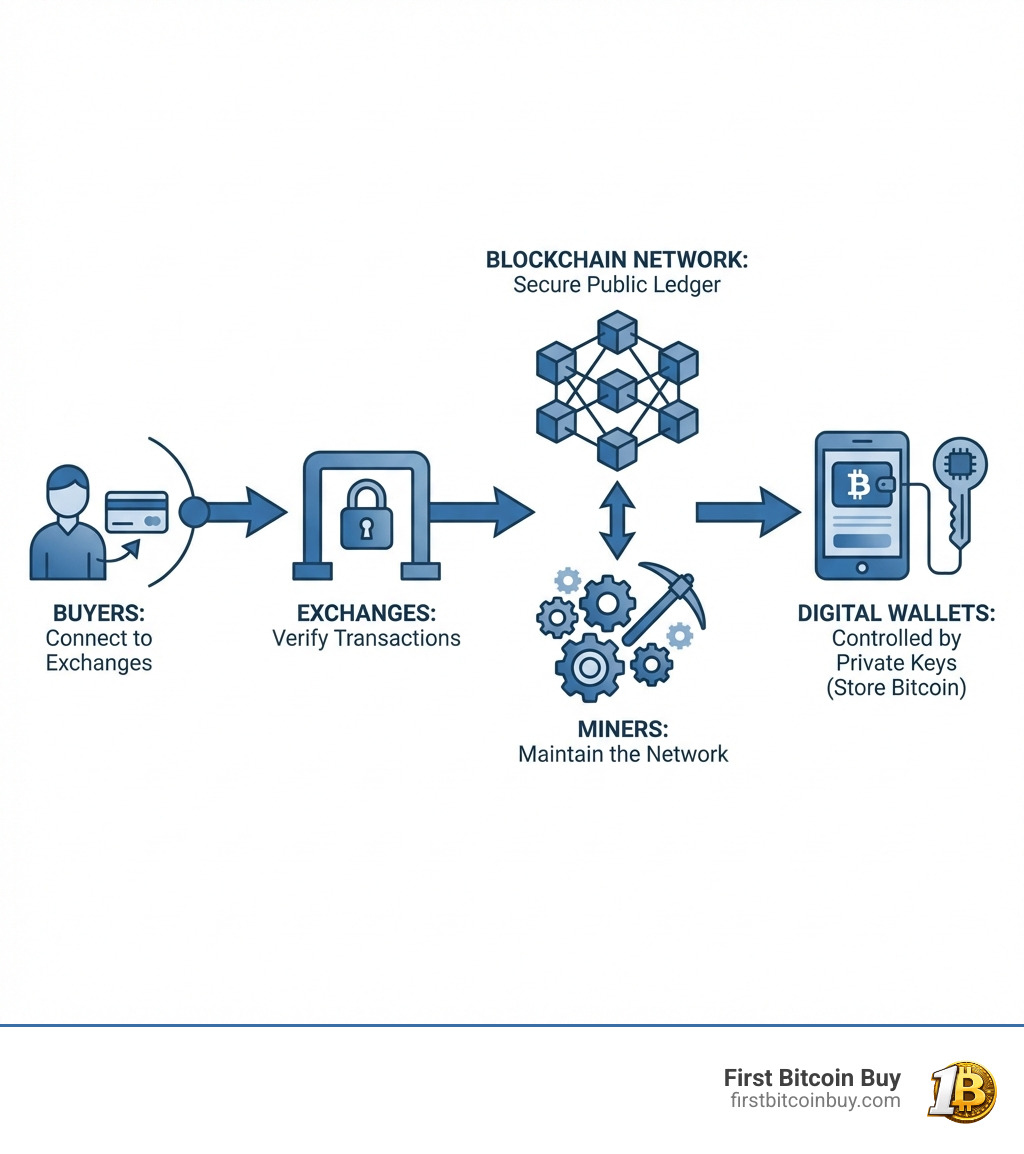
The blockchain is a public digital record book that logs every Bitcoin transaction ever made. It is shared across thousands of computers (called nodes) worldwide, which provides three key benefits:
- Resilience: There is no central database, so there is no single point of failure that could bring the system down.
- Transparency: Anyone can view the movement of funds between wallet addresses, though those addresses are pseudonymous rather than tied to real names.
- Immutability: Once a transaction is confirmed and added to the blockchain, it cannot be changed or reversed, which prevents fraud like double-spending.
For beginners, the most important takeaway is that the blockchain allows the entire world to agree on one shared, tamper-proof history of transactions. If someone tries to spend the same Bitcoin twice, the network automatically rejects the fraudulent attempt.
For more details, explore our Bitcoin beginner guide.
Transaction Verification and Nodes
When you send Bitcoin, your wallet broadcasts a message to the network. This message includes your public address, the recipient’s address, the amount being sent, and a digital signature. Your private key is the secret code that creates this signature and authorizes the transaction. If you lose your private key, you permanently lose access to your funds.
Computers on the network (called nodes) check that you actually have the Bitcoin you are trying to send and that your digital signature is valid. Approved transactions wait in a holding area called the “mempool” until miners bundle them into a new block. This process of collective checking and agreement is known as network consensus.
Here is a simple way to remember the key terms:
- Public address: the destination where people can send you Bitcoin (similar to an email address)
- Private key or seed phrase: the proof that you own your Bitcoin and can spend it (similar to a password, but far more important to protect)
If you want to explore the technical details further, see the official developer documentation.
The Origins and Technology Behind Bitcoin
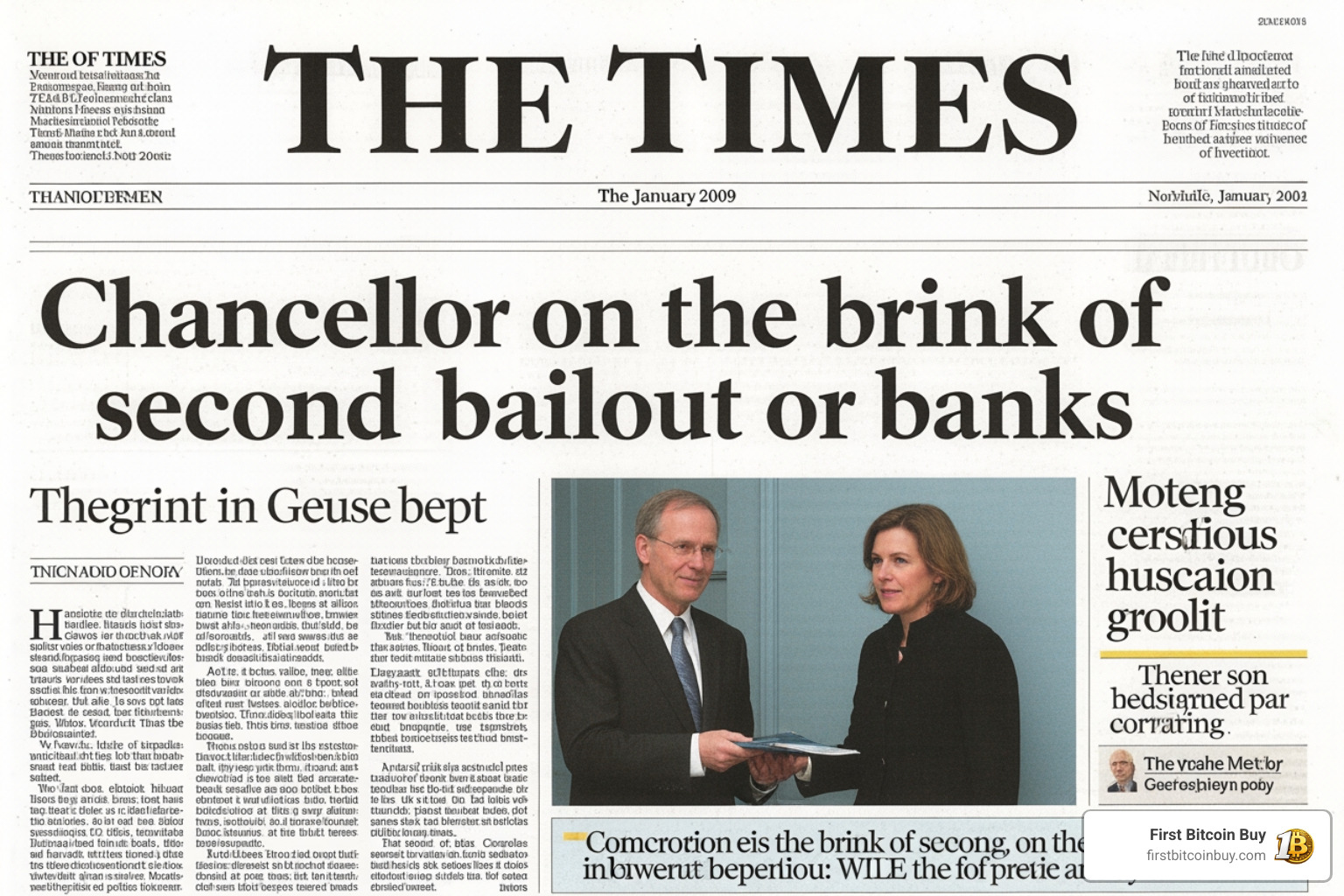
In October 2008, a person or group using the name Satoshi Nakamoto published the Bitcoin white paper, outlining a vision for digital money that did not require trust in any central authority. On January 3, 2009, the Bitcoin network officially launched with the creation of the genesis block — the very first block on the blockchain. Embedded in that block was a message referencing a newspaper headline about bank bailouts, underscoring Bitcoin’s purpose as an alternative to the traditional financial system.
Bitcoin is open-source software, which means anyone in the world can inspect, audit, or propose improvements to its code: Original Bitcoin source code. The fact that Nakamoto’s true identity remains unknown ensures the project is judged on its technical merits rather than the reputation of any individual.
Bitcoin Forks and Network Evolution
Because Bitcoin is open-source and decentralized, changes to the protocol require broad community agreement. These changes happen through “forks”:
- Soft Forks: These are backward-compatible upgrades that tighten the existing rules. A well-known example is SegWit (Segregated Witness), which improved transaction efficiency and reduced fees.
- Hard Forks: These are non-backward-compatible changes that create an entirely separate blockchain. The most notable example is Bitcoin Cash, which split from Bitcoin in 2017 over disagreements about block size.
These forks illustrate how Bitcoin’s decentralized governance works in practice. No single company or developer can force changes on the network — upgrades only succeed when the majority of participants agree to adopt them.
Understanding Bitcoin Mining and Network Security
Bitcoin mining is the process that keeps the network secure and introduces new coins into circulation. It uses a system called Proof of Work (PoW), where miners run specialized hardware to solve complex mathematical puzzles. The first miner to solve the puzzle earns the right to add a new block of transactions to the blockchain, which happens roughly every 10 minutes.
Miners receive two types of payment for their work: a block reward (currently 3.125 BTC per block) and the transaction fees paid by users. To ensure Bitcoin remains scarce over time, a halving event occurs approximately every four years, cutting the block reward in half. This gradual reduction means the last Bitcoin will not be mined until around the year 2140.
The total computing power dedicated to mining is called the hashrate. A higher hashrate means the network is more secure, because an attacker would need an enormous and impractical amount of computing power to compromise it. While Bitcoin mining does consume significant electricity, the industry is increasingly shifting toward renewable energy sources. For more context, see this report on Bitcoin’s electricity consumption.
Incentives and Scarcity
Bitcoin’s security model is built on economic incentives. Miners invest in hardware and electricity because they are rewarded with newly created Bitcoin and transaction fees. This creates a self-sustaining cycle where miners are financially motivated to keep the network honest and operational.
The 21 million cap on total Bitcoin supply creates absolute scarcity — unlike traditional currencies, no central authority can print more Bitcoin. This fixed supply is why Bitcoin is often compared to digital gold and described as a deflationary asset.
Because mining has become highly competitive, many individual miners join mining pools, where they combine their computing power and share the rewards proportionally. Mining pools help ensure that the network remains robust and that smaller participants can still earn consistent rewards.
Investing in BTC: Value, Risks, and ETFs
Bitcoin’s value stems from its scarcity, decentralization, and global utility. However, it is known for extreme volatility, as noted in research on Bitcoin as a volatile asset.
Direct Ownership vs. Bitcoin ETFs
- Direct Ownership: Buying BTC on an exchange like Coinbase and holding it in a wallet. You have full control but must manage your own security. See our start buying bitcoin guide.
- Bitcoin ETFs: Regulated funds that trade on stock exchanges. They offer exposure without the need to manage private keys, though they involve management fees.
Risks of Digital Assets
Investing in Bitcoin involves several risks:
- Volatility: Prices can swing dramatically.
- Regulation: Laws are still evolving and could impact value.
- Security: Exchanges and wallets can be targets for theft.
- Fraud: Scams are common in the unregulated crypto space.
- No Insurance: Unlike bank deposits, BTC is not FDIC-insured.
Conduct thorough due diligence and review the general risks of digital assets before investing.
Practical Guide: How to Buy and Use Bitcoin Safely
Buying Bitcoin for the first time is straightforward when you follow a clear process. Here is how to get started using a reputable exchange like Coinbase:
- Choose an Exchange: We recommend Coinbase for its strong security features and beginner-friendly interface.
- Create an Account: Sign up, complete identity verification (known as KYC, or Know Your Customer), and link a payment method such as a bank account or debit card.
- Fund Your Account and Place an Order: Transfer US dollars into your account and place an order for Bitcoin. You do not need to buy a whole coin — you can purchase small fractions called satoshis.
- Secure Your Bitcoin: For better security, move your Bitcoin from the exchange to a personal, non-custodial wallet that only you control.
For a complete walkthrough with screenshots, see our Coinbase beginner guide.
Storage and Security
How you store your Bitcoin matters just as much as how you buy it. There are two main types of wallets:
- Hot Wallets: These are apps or software connected to the internet. They are convenient for everyday use but carry a higher risk of being hacked.
- Cold Wallets: These are offline hardware devices that store your private keys without ever connecting to the internet. Cold wallets are considered the gold standard for long-term Bitcoin security.
Regardless of which wallet type you use, always enable two-factor authentication on your accounts and never share your private keys or seed phrase with anyone.
Legal Status and Global Adoption
In the United States, the CFTC (Commodity Futures Trading Commission) classifies Bitcoin as a commodity, while the IRS (Internal Revenue Service) treats it as property for tax purposes. This means you may owe capital gains tax when you sell Bitcoin at a profit.
Some US states, like Colorado and Texas, have adopted particularly friendly policies toward digital assets. Globally, adoption varies widely — El Salvador made Bitcoin legal tender in 2021, while other countries have implemented strict restrictions or outright bans. For a comprehensive global overview, see the Library of Congress report on crypto regulation.
Frequently Asked Questions about BTC
Is BTC legal in my country?
Yes, Bitcoin is legal in the United States. It is regulated as a commodity by the CFTC and treated as property by the IRS for tax purposes. You can legally buy, hold, and sell Bitcoin as long as you comply with tax reporting requirements and use regulated platforms like Coinbase.
How do I store BTC safely?
With Bitcoin, you are essentially your own bank, which means security is your responsibility. Use a hot wallet (an internet-connected app) for small amounts you plan to spend soon, and a cold hardware wallet (an offline device) for long-term storage of larger amounts. Your seed phrase is a series of words that serves as your master recovery key — it can restore your wallet if your device is lost or damaged. Never share your seed phrase with anyone, and never store it in a digital file, screenshot, or cloud service.
What determines the price of BTC?
Several factors influence Bitcoin’s price at any given time:
- Supply and Demand: With a fixed maximum supply of 21 million coins, the price rises when more people want to buy than sell, and falls when the opposite is true.
- Market Sentiment: News about institutional adoption, government regulation, or major security breaches can cause rapid price swings.
- Halving Events: Every four years, the rate at which new Bitcoin is created gets cut in half. Historically, these events have been followed by significant price increases.
- Macroeconomic Conditions: Factors like inflation rates, interest rate decisions, and global economic uncertainty can influence whether investors view Bitcoin as an attractive store of value.
Bitcoin’s price is shaped by a complex mix of these factors, which is why most experienced investors recommend taking a long-term perspective rather than reacting to short-term price movements.
Conclusion
Understanding what is BTC is the first step toward taking control of your financial future. From its decentralized origins with Satoshi Nakamoto to its growing role as a modern store of value, Bitcoin offers a transparent and accessible alternative to traditional finance. Throughout this guide, we have covered how Bitcoin works, why mining matters for network security, and the different ways you can invest safely.
Before you make your first purchase, keep these two beginner rules in mind — they prevent the most common and costly mistakes:
- Use reputable, regulated platforms and always double-check website URLs to avoid phishing scams.
- Treat your seed phrase like the key to a vault. Never share it with anyone, never save it as a screenshot, and always keep physical backups stored in a safe, offline location.
At First Bitcoin Buy, our goal is to help you steer Bitcoin with confidence. Prioritize security, stay informed, and always invest only what you can afford to lose.
Ready to get started? Download the free Bitcoin beginner checklist to prepare for your first purchase.
If you plan to use Coinbase, our step-by-step Coinbase beginner guide walks you through buying and securing your Bitcoin with a security-first approach.