

Why a Beginner Guide to Crypto is Essential for Your First Steps
A beginner guide crypto is your roadmap to understanding digital money and making your first safe investment. Cryptocurrency ownership among U.S. investors has surged from just 2% in 2018 to 17% in 2025, reflecting how accessible this technology has become. But for newcomers, the terminology, risks, and fast-moving markets can feel overwhelming.
Quick Start: Your Crypto Basics Checklist
- Understand what crypto is: Digital money secured by cryptography, not controlled by any bank or government
- Learn about blockchain: The transparent public ledger that records all transactions
- Choose a reputable exchange: Start with regulated platforms that prioritize security
- Set up a wallet: Decide between custodial (exchange-managed) or non-custodial (you control the keys)
- Start small: Many beginners invest $50-$100 to learn the process
- Practice security: Enable two-factor authentication and never share your private keys
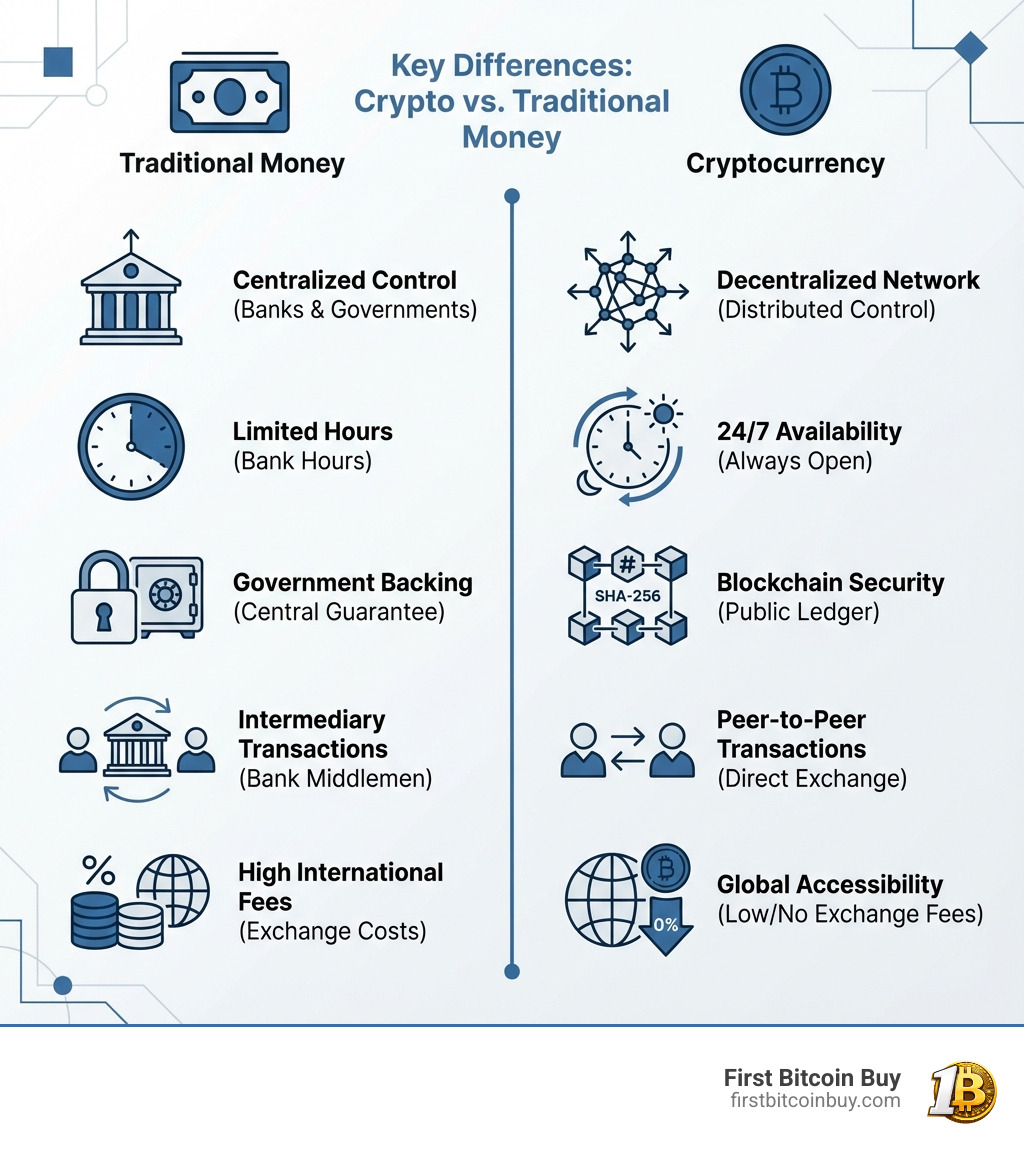
Key Differences: Crypto vs. Traditional Money
| Feature | Traditional Money | Cryptocurrency |
|---|---|---|
| Control | Central banks and governments | Decentralized network |
| Operating Hours | Bank hours (limited) | 24/7 trading |
| Transaction Speed | 1-3 business days | Minutes to hours |
| Backing | Government guarantee | Blockchain technology |
| International Fees | High foreign exchange costs | Low to no conversion fees |
Cryptocurrency is a form of digital payment that exists only online. Unlike cash in your wallet or money in your bank account, crypto runs on blockchain technology—a public ledger where every transaction is recorded and cannot be changed. This peer-to-peer system makes it fast, affordable, and accessible to anyone with an internet connection.
But crypto isn’t without risks. The market is highly volatile, largely unregulated, and vulnerable to scams targeting beginners. That’s why understanding the fundamentals before you invest is critical to protecting your money.
I’m Randy Speckman, and I’ve spent my career helping people steer technology safely and strategically. Through this beginner guide crypto, I’ll walk you through the essentials of buying, storing, and securing your first cryptocurrency—starting with Bitcoin on a trusted platform.
What is Cryptocurrency and How Does It Work?
At its core, cryptocurrency is digital money. It’s a form of payment that only exists online, secured by complex cryptography, and designed to operate without the need for a central authority like a bank or government. Imagine money that you control directly, where transactions are public but your personal identity can remain private. This concept of decentralization is a game-changer.
Unlike traditional currencies, which can lose value due to inflation, many cryptocurrencies have a limited supply, leading some investors to view them as a potential inflation hedge. For instance, Bitcoin has a hard cap of 21 million coins, meaning no more will ever be created.
Understanding Blockchain: The Foundation of Crypto
The magic behind cryptocurrency is a technology called blockchain. Think of it as a huge, continuously growing digital ledger, or a “huge online notebook where every transaction is recorded” as one expert put it. Each “page” in this notebook is a “block” of transactions, and once a block is filled, it’s added to the chain, creating an immutable and transparent record.
“Blockchain is similar to a spreadsheet everyone can see but no one can change,” said Ron Levy, CEO of The Crypto Company. This immutability is key; once a transaction is recorded, it cannot be altered or deleted, enhancing trust and security.
This decentralized network means that instead of a single bank verifying transactions, thousands of computers around the world work together to confirm and record them. This distributed nature makes the system incredibly resilient to fraud and censorship. “Blockchain changes how we think about trust in finance,” said Charley Brady, vice president of investor relations at BitFuFu. “It enables genuine peer-to-peer value transfer on a global scale without relying on traditional financial infrastructure. That decentralization is the true innovation.”
For a deeper dive into the original cryptocurrency, check out our What is Bitcoin? guide.

Crypto vs. Traditional Money
The table in our introduction already highlighted some key differences, but let’s elaborate. Traditional money, like the U.S. dollar, is controlled by a central bank (the Federal Reserve) and the government. They can print more money, influence interest rates, and regulate financial institutions. This provides a sense of stability and, in many cases, consumer protection, such as FDIC insurance for bank accounts.
Cryptocurrency, however, operates outside of this traditional framework. It’s decentralized, meaning no single entity has control. This leads to several distinctions:
- Control: Traditional money is regulated by central banks; crypto is governed by its network participants and code.
- Backing: Traditional money is often backed by the trust in a government and its economy; crypto is backed by the cryptographic security and distributed consensus of its blockchain.
- Transaction Speed & Cost: Sending traditional money internationally can be slow and expensive due to intermediaries. Cryptocurrency transactions are often faster and cheaper, allowing for peer-to-peer transfers across the globe without needing foreign exchange rates.
- Accessibility: Crypto investing is open to anyone with internet access and a computing device, bypassing traditional banking restrictions like ATM withdrawal limits.
While this decentralization offers significant advantages, it also means that crypto lacks many of the regulations and consumer protections that legal-tender currencies and regulated securities have. This is why a thorough beginner guide crypto is so important.

Getting Started: A Beginner Guide to Crypto Investing
So, you’re ready to take the plunge into digital assets. We’re here to help you make your first steps confidently. Getting started typically involves choosing a reputable exchange, funding your account, making your first purchase, and then securely storing your new assets.
Best Cryptocurrencies for Beginners
When starting out, it’s wise to stick with established cryptocurrencies. They tend to have higher market capitalization, more stability (relatively speaking in the volatile crypto world), and widespread adoption. This makes them easier to buy, sell, and understand.
- Bitcoin (BTC): The original cryptocurrency, Bitcoin has the largest market capitalization and is often referred to as “digital gold.” Its value has increased by approximately 12,000 percent since launching in 2009. It’s widely accepted, highly liquid, and the most recognized name in crypto.
- Ethereum (ETH): The second-largest cryptocurrency by market cap, Ethereum is more than just digital money. It’s a platform for smart contracts and decentralized applications (dApps). Ethereum has appreciated at a rate that exceeds 92,000 percent since hitting the market in 2015.
While there are thousands of other cryptocurrencies (known as altcoins), starting with Bitcoin or Ethereum gives you a solid foundation. They are generally considered safer options for beginners to dip their toes into the market.
Curious about how much to invest? Our guide on How Much Bitcoin to Buy? offers practical advice.
How to Buy Cryptocurrency for the First Time
Buying your first crypto doesn’t have to be intimidating. We guide first-time buyers to safely purchase Bitcoin on platforms like Coinbase, known for its beginner-friendly interface and robust security. Here’s a general step-by-step process:
- Choose a Reputable Exchange: Select an exchange that is well-established, regulated in the U.S., and has a strong track record for security. Our focus is on making your first purchase on Coinbase, which is a popular choice for beginners.
- Create an Account: Sign up using your email or mobile number and choose a secure password. Make sure it’s strong!
- Identity Verification (KYC): This is a mandatory step for regulated exchanges in the U.S. You’ll need to provide personal information and possibly a photo ID to comply with “Know Your Customer” (KYC) regulations. This helps prevent fraud and money laundering.
- Link Payment Method: Connect your bank account (for transfers) or debit card. Bank transfers are often the most cost-effective method.
- Place Your First Order: Once your account is funded, you can purchase crypto. For instance, if you want to buy Bitcoin, you’d select BTC, enter the amount you wish to spend (e.g., $50), and confirm the transaction. You don’t need to buy a whole Bitcoin; you can buy fractions.
Many exchanges have no minimum investment amount, and buying fractions of coins is the norm. We recommend starting with a small amount, such as $50 or $100, to get comfortable with the process. For a detailed walkthrough, our Step-by-Step Bitcoin Buying Guide is an excellent resource, and you can even learn how to make Your First $50 in Bitcoin.
Understanding Crypto Wallets
Once you’ve bought crypto, you need a place to store it. This is where crypto wallets come in. A crypto wallet isn’t like a physical wallet holding cash; instead, it stores the private keys that prove your ownership of the cryptocurrency on the blockchain. Losing these keys means losing access to your funds, permanently. There’s no customer service to call.
There are two main types of wallets:
- Custodial Wallets: These are offered by exchanges (like Coinbase). The exchange holds your private keys on your behalf. This is convenient for beginners as the exchange handles the security and management, much like a traditional bank account. However, it means you don’t have full control, and your assets are subject to the exchange’s security practices.
-
Non-Custodial Wallets: You have full control over your private keys. These can be software wallets (apps on your phone or computer) or hardware wallets (physical devices resembling USB drives).
- Hot Wallets: These are connected to the internet (e.g., exchange wallets, mobile apps). They are convenient for frequent transactions but are more vulnerable to online attacks.
- Cold Wallets: These are offline (e.g., hardware wallets, paper wallets). They are considered the most secure for long-term storage of significant amounts of crypto because they are not exposed to online threats.
Hot Wallets vs. Cold Wallets
| Feature | Hot Wallet | Cold Wallet |
|---|---|---|
| Connection | Online (Internet-connected) | Offline (Not connected to Internet) |
| Security | Lower (more vulnerable to hacks) | Higher (less vulnerable to hacks) |
| Convenience | High (easy access for trading) | Lower (requires physical device) |
| Best For | Small amounts, frequent trading | Large amounts, long-term storage |
For beginners, starting with a custodial wallet on a reputable exchange is often the easiest entry point. As your holdings grow, or if you desire more control, moving your assets to a non-custodial cold wallet is a smart move. After your first purchase, understanding these storage options is crucial. Learn more about managing your assets After Your First Bitcoin Buy.
Navigating the Crypto Market: Strategies and Risks
The cryptocurrency market is notorious for its volatility. One day, Bitcoin can hit a new all-time high, and the next, it could drop by 20%. This rollercoaster ride is part of its appeal for some, but also its biggest risk for others. Developing a clear strategy and understanding the inherent risks are paramount for any beginner guide crypto journey.
Popular Investment Strategies for Newbies
Choosing an investment strategy helps you steer market swings without making emotional decisions.
- HODLing (Long-Term Holding): This strategy, a misspelling of “holding” that became a crypto meme, involves buying and holding your cryptocurrencies for an extended period, often months or years, regardless of short-term price fluctuations. It’s a “buy and forget” approach, betting on the long-term growth of the asset. The value of Bitcoin and Ethereum’s parabolic growth since inception makes a strong case for this strategy. HODLing is often among the least stressful options for beginners.
- Dollar-Cost Averaging (DCA): This involves investing a fixed amount of money at regular intervals (e.g., $50 every week or month), regardless of the asset’s price. This strategy reduces the impact of volatility by averaging out your purchase price over time. You buy more when prices are low and less when prices are high.
- Active Trading (Day Trading, Swing Trading, Scalping): These strategies involve frequent buying and selling to profit from short-term price movements.
- Day trading: Buying and selling within the same day. The crypto market is open 24/7, offering continuous opportunities.
- Swing trading: Holding assets for a few days or weeks to capture “swing” movements in price.
- Scalping: Making many small trades throughout the day to capture tiny profits.
While potentially lucrative, active trading strategies like day trading and scalping are generally not recommended for beginners. They require significant time, technical analysis skills, and a high tolerance for risk. Emotional decisions are usually bad decisions in the crypto space, and these strategies amplify that risk. It’s often better to create your own trading system and improve it rather than copying others.
The Main Risks of Investing in Cryptocurrency
We cannot stress this enough: Cryptocurrency-related products carry a substantial level of risk and are not suitable for all investors. Investments in cryptocurrencies are relatively new, highly speculative, and may be subject to extreme price volatility, illiquidity, and increased risk of loss, including your entire investment.
Here are the primary risks you should be aware of:
- High Volatility: Crypto prices can fluctuate wildly and unpredictably. What goes up quickly can come down just as fast.
- Lack of Regulation: The crypto market is still largely unregulated compared to traditional financial markets. This means fewer consumer protections and a higher potential for fraud.
- Security Risks: While blockchain technology itself is secure, exchanges and individual wallets can be vulnerable to hacks, phishing attacks, and other cyber threats. Losing your private keys or seed phrase means your funds are gone permanently.
- Market Manipulation: The relatively smaller size of the crypto market compared to traditional markets makes it more susceptible to manipulation, such as “pump and dump” schemes where insiders artificially inflate prices before selling off.
- Scams and Fraud: The decentralized and less-regulated nature of crypto makes it a hotbed for various scams targeting unsuspecting investors.
- Regulatory Changes: Governments worldwide are still figuring out how to regulate crypto. New laws or bans could significantly impact the market.
- Loss of Principal: You could lose all the money you invest. Only invest what you can afford to lose.
It’s critical to approach crypto investment as a purely speculative instrument due to the high level of risk. For more on safeguarding your assets, see our guide, Is Bitcoin Safe?.
Staying Safe and Compliant in the Crypto World
Protecting your crypto assets and understanding your legal obligations are just as important as knowing how to buy them. Security is paramount, and staying informed about common scams and tax requirements will save you a lot of headaches. We are dedicated to helping newcomers avoid common pitfalls.
A beginner guide crypto security checklist
Your digital security is your first line of defense. Follow these best practices diligently:
- Strong Passwords: Use unique, complex passwords for every crypto-related account. Never reuse passwords. A password manager can help.
- Two-Factor Authentication (2FA): Enable 2FA on all your exchange accounts and wallets. This adds an extra layer of security, usually requiring a code from your phone in addition to your password.
- Anti-Phishing Measures: Be wary of suspicious emails or messages. Enable anti-phishing codes on exchanges if available; this is a custom code that will appear in legitimate emails from the exchange, helping you verify authenticity.
- Securing Private Keys/Seed Phrases: If you use a non-custodial wallet, your seed phrase (a list of words) is the ultimate key to your funds. Write it down, store it offline in multiple secure locations, and never share it with anyone.
- Using Reputable Exchanges: Stick to well-established and trusted exchanges. Ensure the exchange is compliant with financial laws in your jurisdiction.
- Regular Software Updates: Keep your operating system, browser, and wallet software updated to protect against known vulnerabilities.
For a comprehensive list of best practices, grab our Free Bitcoin Beginner Checklist. Also, learn about some common missteps in our Common Bitcoin Mistakes guide.
Common Scams and How to Avoid Them
The crypto space is rife with scams, primarily targeting less experienced investors. Be vigilant!
- Phishing Emails and Fake Websites: Scammers create fake websites or send emails that look legitimate to trick you into revealing your login credentials or private keys. Always double-check URLs and email senders.
- Pump and Dump Schemes: These involve artificially inflating the price of a lesser-known coin through coordinated buying, only for the organizers to sell off their holdings at the peak, leaving others with worthless assets.
- Rug Pulls: Developers of a new coin or project suddenly abandon it, taking investors’ funds with them. This is common in decentralized finance (DeFi) projects.
- Social Media Impersonators: Scammers often pose as influential figures or even customer support on platforms like Twitter or Telegram, offering fake giveaways or “investment opportunities.”
- Never Share Your Seed Phrase: This is the golden rule. Anyone asking for your seed phrase, private keys, or login details is a scammer, no matter what they promise. Exchanges and legitimate services will never ask for this information.
Always stick to official sources of information and trustworthy news outlets to avoid misinformation. If something sounds too good to be true, it almost certainly is.
Understanding Cryptocurrency Taxes
In the United States, the IRS treats cryptocurrency as property for tax purposes, similar to how stocks or bonds are treated. This means that certain actions involving your crypto can trigger a taxable event.
- Taxable Events:
- Selling crypto for fiat currency (e.g., USD).
- Trading one cryptocurrency for another (e.g., Bitcoin for Ethereum).
- Spending crypto to buy goods or services.
- Earning crypto through mining, staking, or airdrops (this is often taxed as ordinary income).
- Capital Gains and Losses: If you sell, trade, or spend crypto, you’ll incur a capital gain or loss. If you held the asset for less than a year, it’s a short-term gain/loss (taxed at ordinary income rates). If you held it for more than a year, it’s a long-term gain/loss (generally taxed at lower rates).
- Reporting Requirements: You are responsible for accurately reporting all your crypto transactions to the IRS. Many exchanges issue 1099 forms, but these might not cover all your taxable events, especially if you trade across multiple platforms or use non-custodial wallets. It’s often beneficial to use crypto tax software or consult with a tax professional experienced in crypto.
It’s crucial to keep meticulous records of all your crypto activities, including dates of purchase/sale, cost basis, and fair market value at the time of transaction. Seek professional advice from tax and investment advisors for specific situations. For more general resources, including guides and tools, visit our Resources page.
Frequently Asked Questions about Crypto for Beginners
Can I buy just a small fraction of a cryptocurrency?
Yes, you don’t need to buy a whole coin. You can start with a small amount, like $50 or less, to buy a fraction of a cryptocurrency like Bitcoin. This is a common practice for beginners learning the ropes. Many exchanges have no minimum investment amount, allowing you to buy as little as 5 EUR worth of Bitcoin, for example.
Do I need a special bank account for crypto?
No, you do not need a special bank account. You can fund your account on a cryptocurrency exchange using your regular bank account via methods like bank transfers or by using a debit card. Most centralized exchanges allow users to deposit fiat currency from their bank accounts.
How is the price of a cryptocurrency determined?
The price is determined by supply and demand in the market. Factors like adoption, investor sentiment, news, and regulatory changes can all influence the price of a cryptocurrency on various exchanges. High volatility is a characteristic of this market, meaning prices can change rapidly based on these factors.
Your Next Steps on the Crypto Journey
We’ve covered a lot in this beginner guide crypto! From understanding what cryptocurrency is and how blockchain works, to making your first purchase, choosing a wallet, and navigating the inherent risks and security measures—you now have a solid foundation.
The crypto space is constantly evolving, but with a solid foundation in the basics, you can steer it safely. Remember to start small, prioritize security, and never invest more than you can afford to lose. First Bitcoin Buy is dedicated to helping newcomers avoid common pitfalls and make informed decisions.
For a complete walkthrough on getting started with the world’s first and largest cryptocurrency, check out our comprehensive Bitcoin Beginner Guide. Your journey to becoming a crypto hero starts now!