

Why Understanding Cryptocurrency Is Essential Today
A Beginner crypto guide is your first step toward navigating digital money. Here’s what you need to know right now:
Quick Answer: What Is Cryptocurrency?
- Digital money that exists only online, secured by cryptography
- Decentralized system not controlled by banks or governments
- Powered by blockchain technology that records all transactions transparently
- Peer-to-peer transactions that happen directly between people
- Bitcoin was the first cryptocurrency, created in 2009
Cryptocurrency represents a fundamental shift in our concept of money. It emerged from concerns that traditional currency is too reliant on banks and governments. Crypto uses technology to create a system where people can transact directly, without middlemen.
Cryptocurrency ownership has grown dramatically, evolving from a niche interest to a mainstream investment. It’s no longer a fringe technology.
But here’s the truth: crypto can feel overwhelming at first. With new vocabulary and technical concepts, it’s easy to feel lost. The good news is you don’t need to be an expert to start safely.
I’m Randy Speckman, and I specialize in making technology accessible. This Beginner crypto guide breaks down everything you need to know into simple, actionable steps—no jargon required.
Introduction: What is Cryptocurrency?
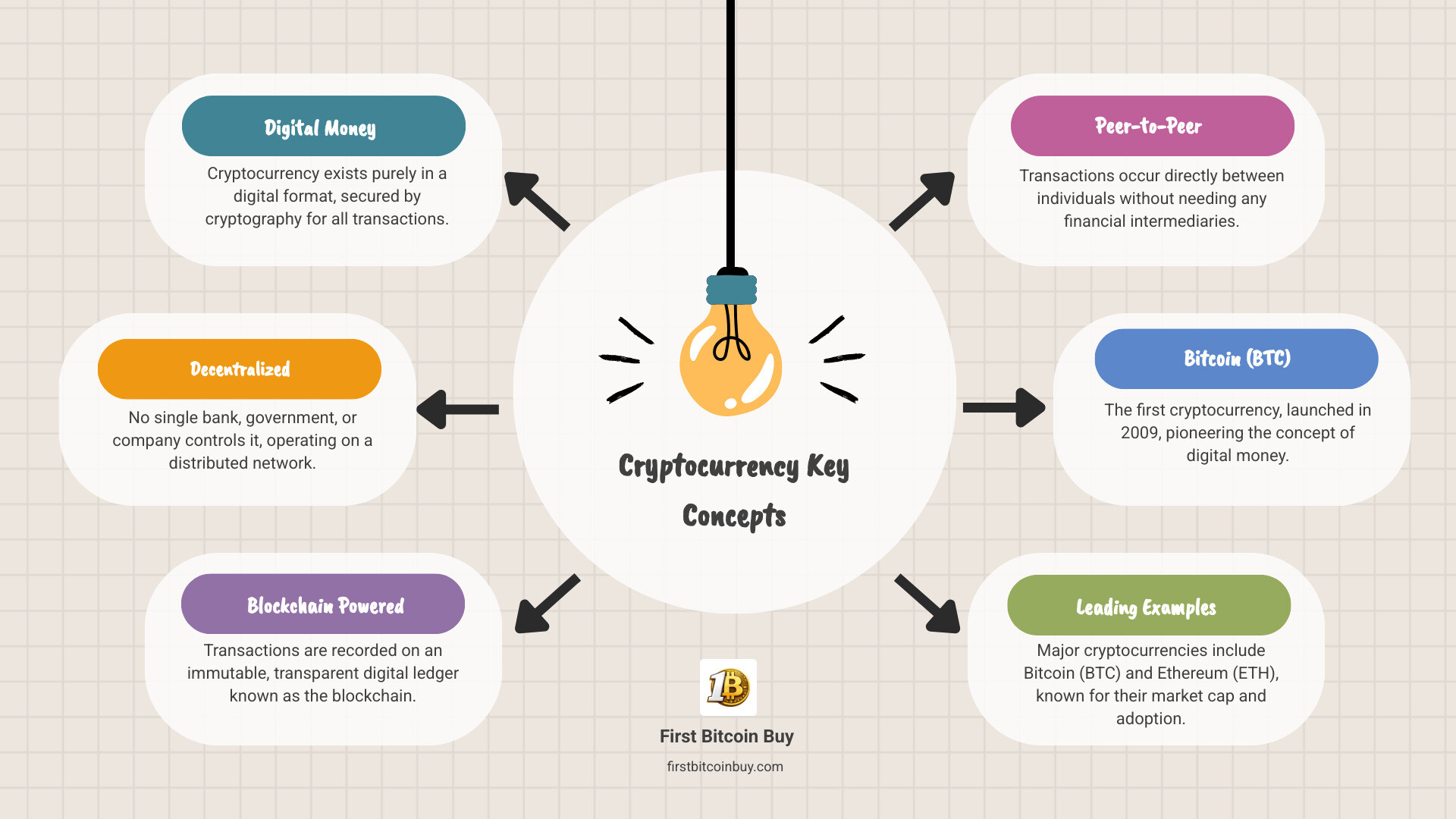
Cryptocurrency is digital money, plain and simple. Unlike the dollars in your wallet or bank account, crypto exists purely in a digital format. It’s secured by something called cryptography, which makes transactions incredibly secure and verifies the transfer of digital assets.
The core difference is decentralization. Traditional money is controlled by central authorities like banks and governments. They print money, set rates, and process transactions. Cryptocurrencies operate on a decentralized network, meaning no single entity has control. This was the vision of Bitcoin’s anonymous creator, Satoshi Nakamoto, who was concerned about the reliance on “middlemen.”
This decentralization has several advantages. Transactions are peer-to-peer, meaning you can send money directly to anyone, anywhere, without a bank. This can result in faster, cheaper international transactions. Additionally, many cryptocurrencies like Bitcoin have a finite supply (21 million coins), which some view as a hedge against the inflation of traditional currencies that can be printed endlessly.
Bitcoin, as the first and most well-known cryptocurrency, paved the way for this new financial frontier. If you’re curious to dive deeper into its origins, check out our guide on What is Bitcoin?.
Coins vs. Tokens Explained
As you explore the crypto world, you’ll often hear the terms “coins” and “tokens.” While sometimes used interchangeably, there’s a key distinction that’s helpful for any Beginner crypto guide to understand.
Simply put, a “coin” is a cryptocurrency that operates on its own independent blockchain. Think of it as having its own dedicated highway. Bitcoin (BTC) and Ethereum (ETH) are prime examples. They have their own underlying technology, and their primary function is often as a digital currency for transactions, or as the native asset that powers their blockchain.
“Tokens,” on the other hand, are cryptocurrencies that are built on an existing blockchain. They don’t have their own independent blockchain. Instead, they leverage the technology and security of a parent blockchain, like Ethereum. ERC-20 tokens, for instance, are tokens built on the Ethereum blockchain. Tokens can represent a wide variety of assets or utilities—from ownership in a project, to a voting right in a decentralized autonomous organization (DAO), or even digital collectibles (NFTs). They are incredibly versatile and have enabled a vast ecosystem of decentralized applications.
Here’s a quick comparison:
| Feature | Coins (e.g., Bitcoin, Ethereum) | Tokens (e.g., ERC-20 tokens, NFTs) |
|---|---|---|
| Native Blockchain | Yes, they have their own independent blockchain. | No, they are built on an existing blockchain (e.g., Ethereum, Solana). |
| Primary Use | Often used as digital money, store of value, or network fees. | Can represent assets, utility, governance rights, or digital collectibles. |
| Independence | Fully independent, govern their own network rules. | Dependent on the parent blockchain’s rules and security. |
The Engine Behind Crypto: Understanding Blockchain Technology
At the heart of cryptocurrency is blockchain technology. It’s simpler than it sounds: imagine a digital ledger, like a giant, unchangeable spreadsheet shared across a network. This ledger is a chain of “blocks,” with each block containing a list of verified transactions.

When a transaction occurs, it’s grouped into a “block.” Network participants verify this block, and once confirmed, it’s added to the chain, creating a permanent, transparent record. Cryptography links each block to the previous one, making it virtually tamper-proof. As Ron Levy, CEO of The Crypto Company, says, “Blockchain is similar to a spreadsheet everyone can see but no one can change.” This process ensures the system’s integrity.
Blockchain’s beauty is its decentralization. Instead of one bank holding the records, copies are distributed across thousands of computers. This means Blockchains ensure someone cannot randomly pick a block to mine or alter it. Changing a transaction would require altering every subsequent block on every computer—an impossible task. This immutability and transparency build trust.
As Charley Brady, vice president of investor relations at BitFuFu, notes, “Blockchain changes how we think about trust in finance. It enables genuine peer-to-peer value transfer on a global scale without relying on traditional financial infrastructure. That decentralization is the true innovation.” This robust, transparent, and secure system is what makes cryptocurrency possible.
How New Coins Are Created: Mining and Staking
So, if no central bank prints cryptocurrency, how do new coins come into existence? This happens through two primary mechanisms: mining and staking.
Cryptocurrency Mining (Proof-of-Work – PoW)
Mining is the process used by cryptocurrencies like Bitcoin to create new coins and validate transactions. It involves powerful computers solving complex mathematical puzzles. The first computer to solve the puzzle gets to add the next block to the blockchain and is rewarded with newly minted coins. This is known as Proof-of-Work (PoW).
However, PoW is incredibly energy-intensive. Miners use specialized, power-hungry hardware, leading to environmental concerns. For example, a single Bitcoin transaction requires approximately 1449 kWh, which is equivalent to about 50 days of power usage for the average US household. This energy demand is a key reason why alternatives like Proof-of-Stake were developed.
Staking (Proof-of-Stake – PoS)
As an alternative to energy-intensive mining, many newer cryptocurrencies, and even Ethereum, use a method called Proof-of-Stake (PoS). Instead of competing to solve puzzles, participants (called “validators”) “stake” a portion of their existing coins as collateral. The network then randomly selects one of these validators to create the next block and earn a reward. The more coins a validator stakes, the higher their chance of being selected.
PoS is far more energy-efficient than PoW. It secures the network through economic incentives: validators risk losing their staked coins if they act maliciously. Staking allows coin holders to earn passive income by helping secure the network, without needing specialized hardware or high electricity bills.
Your Complete Beginner Crypto Guide to Getting Started
Ready to take your first steps into crypto? This section of our Beginner crypto guide will walk you through the essential tools and considerations for starting your investment journey.
Essential Tools Needed to Start Investing in Cryptocurrency
To begin investing in cryptocurrency, you’ll need two primary tools:
-
A Cryptocurrency Exchange Account: This is where you’ll buy, sell, and trade cryptocurrencies. Think of it like a stock brokerage account, but for digital assets. For beginners in the U.S., platforms like Coinbase are popular choices due to their user-friendly interfaces and robust security features. When choosing an exchange, look for one that is reputable, has reasonable fees, and offers the cryptocurrencies you’re interested in. You’ll typically need to verify your identity (a process called KYC – Know Your Customer) by providing personal information and a form of ID.
-
A Crypto Wallet: A crypto wallet is software or hardware that stores the private keys to your cryptocurrencies, allowing you to access and manage your digital assets. While exchanges often provide a custodial wallet (meaning they hold your keys for you, much like a bank holds your money), many experienced users prefer to control their own keys with a non-custodial wallet for greater security. We’ll dive deeper into wallets in the security section.

Considerations Before Making Your First Investment
Before you jump in, it’s crucial to do some homework and self-reflection. This isn’t just about picking a coin; it’s about understanding your own financial situation and risk tolerance.
-
Define Your Investment Goals: Why are you investing in crypto? Are you looking for long-term growth, short-term gains, or simply experimenting with a small amount? Having clear goals will help you choose appropriate strategies and manage expectations.
-
Understand Your Risk Tolerance: Cryptocurrencies are highly volatile. Prices can swing dramatically in short periods. Cryptocurrency-related products carry a substantial level of risk and are not suitable for all investors. Only invest money you can afford to lose. We emphasize starting small and gradually increasing your exposure as you learn. For guidance on how much to allocate, check out our insights on How Much to Buy?.
-
Do Your Own Research (DYOR): Don’t just follow hype. Research the cryptocurrencies you’re interested in. Understand their technology, use case, team, and market capitalization.
-
Start Small: Many exchanges allow you to buy fractions of a coin. You don’t need to buy a whole Bitcoin! Consider starting with a small, manageable amount, perhaps $50 or $100, to get a feel for the process and market dynamics. This way, you can learn without significant financial pressure. Our Step-by-Step guide can help you with your first purchase.
Best Cryptocurrencies for a Beginner Crypto Guide
When you’re starting out, the sheer number of cryptocurrencies can be overwhelming. For a Beginner crypto guide, we recommend starting with well-established, larger-cap coins that have proven track records and strong communities.
Here are a few generally considered good starting points for beginners in the U.S.:
- Bitcoin (BTC): The original cryptocurrency, often called “digital gold” for its finite supply and role as a store of value. As the largest and most adopted crypto, it’s a foundational asset for many portfolios.
- Ethereum (ETH): The second-largest crypto. Ethereum is a decentralized platform for building applications (dApps) using smart contracts. Its vast ecosystem makes it a cornerstone of the crypto world.
- Litecoin (LTC): Called the “silver to Bitcoin’s gold,” Litecoin was designed as a faster, lighter version of Bitcoin, offering quicker transactions and lower fees.
- Cardano (ADA): Known for its research-driven, sustainable approach. Cardano uses energy-efficient Proof-of-Stake and aims to be a secure, scalable platform for dApps.
While we encourage you to do your own research, starting with these established coins can provide a more stable entry point into the market compared to smaller, highly speculative altcoins.
Common Investment Strategies
Once you’ve made your first purchase, what next? Having a strategy is key, even for beginners. Here are some common approaches:
-
Long-Term Holding (HODLing): This is perhaps the simplest strategy and often recommended for beginners. “HODL” is a crypto slang term (originating from a misspelling of “hold”) that means buying cryptocurrency and holding onto it for an extended period, regardless of short-term price fluctuations. The idea is to bet on the long-term growth of the asset. As one expert noted, “If you approach crypto investment as a long-term strategy, the ups and downs will likely be less concerning since short-term fluctuations will impact your strategy differently.” Bitcoin, for example, has seen massive appreciation since its launch in 2009.
-
Short-Term Trading: This involves buying and selling cryptocurrencies frequently to profit from price swings.
- Day Trading: Executing multiple trades within a single day. This is highly risky and generally not recommended for beginners due to the intense focus and rapid decision-making required.
- Swing Trading: Holding assets for a few days or weeks to capture gains from “swings” in price. This requires technical analysis skills and market understanding.
-
Dollar-Cost Averaging (DCA): This strategy involves investing a fixed amount of money at regular intervals (e.g., $50 every week or month), regardless of the asset’s price. This averages out your purchase price over time, reducing the risk of buying all your assets at a market peak. It’s an excellent strategy for beginners as it removes emotional decision-making and allows you to build a position over time.
For more insights into managing your investments after your initial purchase, read our guide on After Your First Buy.
Navigating Risks, Security, and Taxes
Investing in cryptocurrency comes with its own set of challenges and responsibilities. As your Beginner crypto guide, we want to ensure you’re well-prepared to steer the risks, protect your assets, and understand your tax obligations.
The Most Significant Risks Associated with Cryptocurrency Investments
While the potential rewards of crypto can be exciting, it’s crucial to be aware of the substantial risks involved:
- Market Volatility: This is perhaps the most well-known characteristic of crypto. Prices can soar or plummet by significant percentages in a single day, or even hours. This extreme volatility means you can gain or lose money very quickly.
- Lack of Regulation: In the U.S., the regulatory landscape for cryptocurrency is still evolving. Digital currencies lack many regulations and consumer protections that are common in traditional financial markets. This can expose investors to more fraud and security breaches.
- Security Risks: While blockchain technology itself is secure, the platforms and methods used to store and trade crypto can be vulnerable. Exchanges can be hacked, and individual wallets can be compromised if not properly secured.
- Scams and Fraud: The unregulated nature and high hype surrounding crypto make it a fertile ground for scams. Common types include:
- Phishing: Attempts to trick you into revealing your private keys or login credentials through fake websites or emails.
- Pump-and-Dump Schemes: Where fraudsters artificially inflate the price of a low-value coin through false hype, then sell their holdings, causing the price to crash and leaving other investors with losses.
- Fake Exchanges/Wallets: Malicious platforms designed to steal your funds.
- Rug Pulls: Developers of a new token suddenly abandon the project and drain its liquidity, leaving investors with worthless tokens.
Understanding these risks is the first step in mitigating them. For a deeper dive into pitfalls to avoid, check out our page on Common Mistakes.
Essential Security Tips: A Beginner Crypto Guide to Safety
Protecting your cryptocurrency assets is paramount. Here are essential security tips for beginners:
- Use Strong, Unique Passwords: This sounds basic, but it’s your first line of defense. Use a complex combination of letters, numbers, and symbols, and never reuse passwords across different platforms.
- Enable Two-Factor Authentication (2FA): Always enable 2FA on your exchange accounts and wallets. This adds an extra layer of security, usually requiring a code from your phone (via an authenticator app like Google Authenticator) in addition to your password.
- Understand Wallets: Hot vs. Cold:
- Hot Wallets: Connected to the internet (e.g., exchange wallets, mobile apps). Convenient for frequent trading but more vulnerable to hacks.
- Cold Wallets (Hardware Wallets): Physical devices that store keys offline. They are the most secure option for long-term storage. We recommend a hot wallet for small, active amounts and a cold wallet for larger holdings.
- Guard Your Private Keys and Seed Phrases: Your private keys are what give you ownership of your crypto. If you lose them, your crypto is gone forever. If someone else gets them, they can steal your crypto. Many non-custodial wallets provide a “seed phrase” (a list of 12-24 words) that can restore your wallet. Write this down physically, store it securely offline, and never share it with anyone.
- Be Wary of Phishing and Scams: Always double-check URLs, emails, and messages. Legitimate crypto companies will almost never ask for your private keys or seed phrase. If something seems too good to be true, it probably is.
- Use Reputable Exchanges: Stick to well-known, established exchanges with a strong security record.
Your digital assets are your responsibility. For more detailed security advice, including how to make sure Is Bitcoin Safe?, visit our Security section.
Understanding Cryptocurrency Taxes
Crypto taxes can be tricky for beginners. In the U.S., the IRS treats cryptocurrency as property for tax purposes, like stocks. This is a crucial distinction.
Here’s what that means for you:
-
Taxable Events: Any time you “dispose” of your cryptocurrency, it’s generally considered a taxable event. This includes:
- Selling Crypto for Fiat Currency: If you sell Bitcoin for U.S. dollars, any gain or loss is taxable.
- Trading One Crypto for Another: If you trade Bitcoin for Ethereum, this is also a taxable event. You’ve effectively “sold” your Bitcoin for Ethereum.
- Using Crypto to Pay for Goods or Services: If you buy a coffee with Bitcoin, the IRS views this as selling your Bitcoin for its fiat equivalent value, and then using that fiat to buy the coffee.
- Earning Crypto: Receiving crypto as income (e.g., from mining, staking, or airdrops) is generally taxed as ordinary income at the time you receive it.
-
Capital Gains and Losses: Just like with stocks, if you hold crypto for less than a year before selling or trading it, any profit is considered a short-term capital gain and is taxed at your ordinary income tax rate. If you hold it for more than a year, it’s a long-term capital gain, which typically has a lower tax rate. Losses can be used to offset gains.
-
Reporting Requirements: You are responsible for accurately tracking and reporting your crypto transactions to the IRS. Many exchanges will provide 1099 forms, but these might not capture all your taxable events, especially if you’re trading between different cryptocurrencies or using multiple platforms. It’s often recommended to use crypto tax software to help calculate your gains and losses and generate the necessary tax forms.
Tax laws are complex and can change, so it’s always best to consult with a qualified accountant or tax professional for personalized advice. For more general information on compliance, you can Read more about tax considerations. Also, understanding Fees Explained on exchanges can impact your overall tax calculations.
Frequently Asked Questions about Cryptocurrency
We understand you likely have many questions as you dive into this new world. Here are some of the most common ones we encounter in our Beginner crypto guide. You can find more answers on our dedicated FAQ page.
What are the main differences between a crypto coin and a token?
Coins operate on their own native blockchain, like Bitcoin. Tokens are built on top of an existing blockchain, like many projects on Ethereum. Coins are generally used as money, while tokens can represent assets or utility.
Can I buy just a small fraction of a Bitcoin?
Yes. You don’t need to buy a whole Bitcoin. You can buy small fractions, which makes it accessible to start with a small amount of money, like your First 50 Dollars.
What is the easiest way to store my crypto as a beginner?
For beginners, the simplest method is often using the custodial wallet provided by the exchange where you buy your crypto. This means the exchange holds the private keys for you. As you become more experienced, you may want to explore non-custodial hot or cold wallets for more control over your assets.
What is cryptocurrency and how does it differ from traditional money?
Cryptocurrency is a digital or virtual currency secured by cryptography, making it nearly impossible to counterfeit or double-spend. It’s decentralized, meaning it’s not subject to government or financial institution control. Traditional money, also known as fiat currency (like the U.S. dollar), is issued and regulated by central banks and governments. The key differences are decentralization, security mechanisms, and the absence of physical form for crypto.
What are the advantages of using cryptocurrency compared to traditional currency?
Cryptocurrency offers several advantages:
- Decentralization: No single entity controls it, reducing censorship and manipulation.
- Lower Fees: International transfers can be cheaper and faster than traditional banking.
- Speed: Transactions can often be processed much quicker, especially cross-border.
- Security: Cryptography makes transactions highly secure and irreversible once confirmed.
- Transparency: All transactions are recorded on a public ledger (blockchain), offering transparency while maintaining user pseudonymity.
- Accessibility: Anyone with an internet connection can access crypto, potentially banking the unbanked.
What are some common cryptocurrency scams and how can beginners avoid them?
Common scams include phishing, pump-and-dump schemes, fake exchanges, and investment scams promising unrealistic returns. To avoid them:
- Verify Everything: Always double-check website URLs, email addresses, and sender identities.
- Never Share Private Keys/Seed Phrases: No legitimate project or support will ever ask for these.
- Beware of “Guaranteed Returns”: If an investment promises incredibly high or guaranteed returns, it’s almost certainly a scam.
- Research Projects Thoroughly: Understand what you’re investing in. Look for reputable teams and clear use cases.
- Use Reputable Platforms: Stick to well-known exchanges and wallet providers.
Your Next Steps in the Crypto World
We’ve covered the essentials in this Beginner crypto guide, from blockchain basics to investing, security, and taxes. The crypto world is always evolving, so continuous education is key. Our mission at First Bitcoin Buy is to help you safely purchase digital assets. By starting small, doing your research, and prioritizing security, you can confidently explore this space.
To further assist you on your journey, we offer comprehensive resources. For a detailed, step-by-step walkthrough on setting up your account and making your first purchase securely, we highly recommend you download our complete Coinbase Beginner Guide. You can also explore our wider range of Resources to deepen your understanding.
Don’t forget to grab your Free Checklist: Bitcoin Beginner to keep track of your progress and ensure you’re covering all the bases! The crypto journey is a marathon, not a sprint, and we’re here to help you every step of the way.